
This is Mazon Monday post #316. What’s your favorite Mazon Creek fossil? Tell us at email:esconi.info@gmail.com.
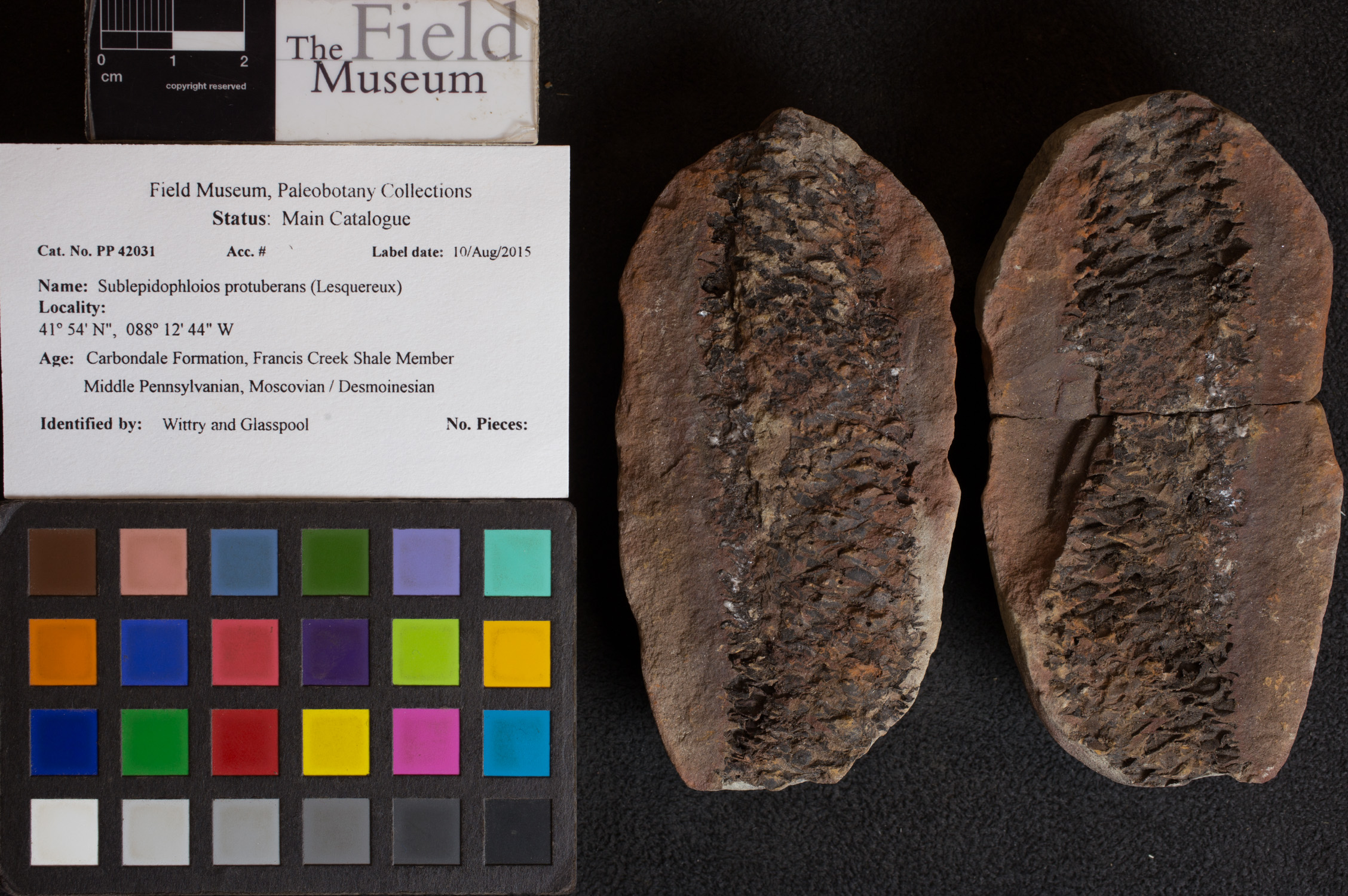
Today, we have Sublepidophloios protuberans, which is a species of lycopsid branch. It’s very common, actually the most common form of lycopsid bark in the Mazon Creek fossil flora.
George Langford thought the various forms of Sublepidophloios represented growth stages of the plants. He used the name Lepidophloios laricinus to designate the infant form.


Recall that paleobotany uses form genera as a strategy to identify plant parts. If you aren’t familiar with the concept, there is a good explanation in ESCONI’s “Keys to Identify Pennsylvanian Fossil Plants of the Mazon Creek Area”.
THE CONCEPT OF FORM-GENERA IN IDENTIFYING FOSSIL PLANTS
Biologists and paleobiologists who study and classify organisms often find biological structures that cannot be confidently assigned to any known organismic species. Such structures — mostly parts, life-stages, or sedimentary traces of organisms contain considerable biological information and provide insights into the morphology, life-style, and behavior of past (and present) species. For example, for many present-day fungi, both the asexual and sexual stages of the life-cycle is known, but each stage cannot be causally linked to the other. These stages may have separate, taxonomic names, yet belong to the same species. Similarly, trace fossils distinctively-shaped impressions and burrows indicating particular behavioral habits are given separate taxonomic names, and are not assuredly linked to any known fossil species.
And so it is with fossil plants, in which particular organs are preserved in isolation from other organs belonging to the same plant species. Thus plant leaves, roots, stems, fruits, seeds, and even pollen or spores, have separate taxonomic names. These names are termed “form genera”. Several form-genera, each designating a specific part of the plant, can refer to a single fossil plant species, but it is often impossible to know which leaf-genus is associated with which seed-genus or pollen-genus, and so on.
Furthermore, in some cases it is clear that structures assigned to one form were actually produced by two or more different kinds of plants, e.g., Lepidophylloides produced by both Sigillaria and Lepidodendron. Therefore, even when we can demonstrate, or hypothesize, that two or more form-genera are actually part of a single plant species, we cannot be certain that all fragmentary specimens of the genera are correctly treated in this way. For these reasons, form-genera are an indispensable, if slightly confusing, tool in identifying fossil plants.
Sublepidophloios protuberans appears on pages 12 and 13 of Jack Wittry’s “A Comprehensive Guide to the Mazon Creek Fossil Flora”
Sublepidophloios protuberans (Lesquereux) Thomas et al., 2013
1870. Lepidophloios protuberans Lesquereux: p. 440, pl. 36, figs. 1, 2
1879-80. Lepidophloios protuberans Lesquereux: p. 425, pl. 68, fig. 9
1925. Lepidophloios protuberans Lesquereux; Noé: pl. 8, fig. 1
1940. Lepidodendron volkmanianum (non Sternberg); Janssen: pl. 3, Fig. 1
1958. Lepidophloios protuberans Lesquereux; Langford: p. 78, figs. 138-142
1958. Lepidophloios laricinus (non Sternberg); Langford: p. 78, fig. 132
1979. Lepidophloios protuberans Lesquereux; Janssen: p. 49, fig. 27
2013. Sublepidophloios protuberans Lesquereux; Thomas et al.: p. 321, fig. 4CDESCRIPTION: In the first stages of growth with branches of less than 2.5 cm (see Fig. 1), the leaf cushion is as tall as it is wide. The leaf scars touch and are deep, sharply inflated, and downturned. As the diameter of the stem increases, the leaf cushions grow relatively taller and become more separated (see Fig. 3). In the intermedi-ate and fully mature stage (see Fig. 5), the leaf cushions become distant, rounded at the top with the sides acute, and taller and acuminate at the bottom. They appear to have a thick bark that is deeply striate lengthwise and often has a covering of coal that fills the leaf scars and obscures the details.
REMARKS: Sublepidophloios protuberans is very common and the most common form of lycopsid bark in the Mazon Creek flora. Two species of Lepidophloios (Sublepidophloios) were noted in the Mazon Creek flora by Langford (1958). He also noticed that it was impossible for him to separate the many forms caused by successive stages of growth into distinct species. He observed that all smaller branches (see Figs. 1, 4) had similar characteristics and are comparable to Lepidophloios laricinus. All of the larger branches, however (see Fig. 5), had a different leaf cushion pattern and were given the name Lepidophloios protuberans by Lesquereux. Later, for an unpublished Book 3, Langford studied 75 specimens of Lepidophloios (Sublepidophloios) under a microscope, photographed and sketched 41 of them, and stated, “All of the specimens possess the same fundamental characteristics and that the differences are merely changes in size and proportion finally modified considerably by the addition of subcutaneous growths.” If not for the hundreds of specimens to study many showing transitional forms one could easily think that there were at least two, if not several, distinct species. However, this seems not to be the case. Certainly, most, if not all, examples of Sublepidophloios in the Mazon Creek flora are in fact the same species. This author agrees with Langford that the specific name protuberans, originally erected by Lesquereux from Mazon Creek fossils, should be used on nearly all forms of Sublepidophloios found in the Mazon Creek flora.
In Fig. 4, two circular branch scars are visible. It is debated whether these scars were formed from abscised vegetative branches during normal growth or mark the former positions of specialized branches that bore clusters of cones.
Specimens
Field Museum PP 30332

Field Museum PP 15236

Field Museum PP 42026

Field Museum PP 42031

Field Museum PP 27906 (From Wittry “A Comprehensive Guide to the Mazon Creek Fossil Flora”)

From George’s Basement


Leave a Reply