
This is Mazon Monday post #322. What’s your favorite Mazon Creek fossil? Tell us at email:esconi.info@gmail.com.

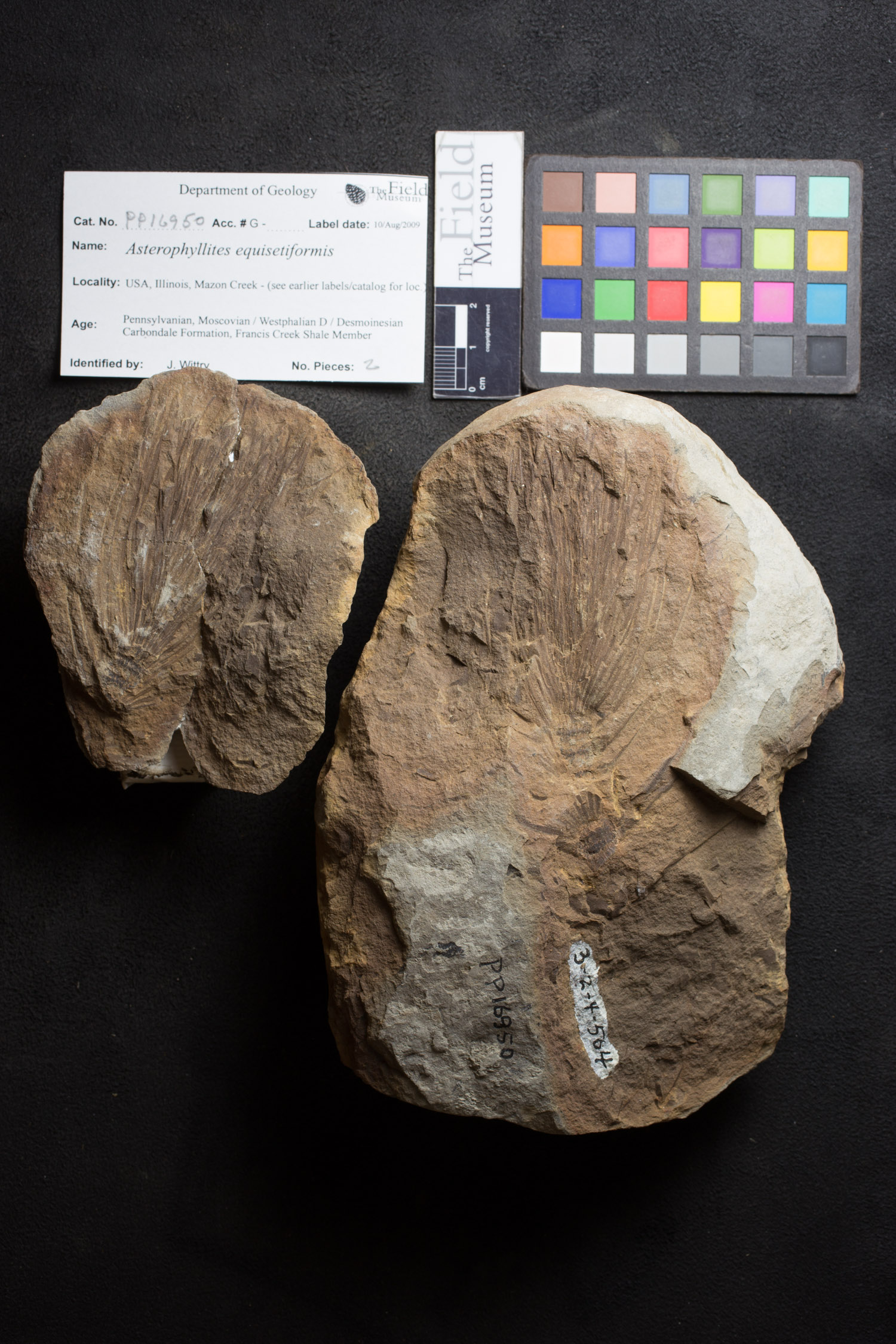
Asterophyllites longifolius like its sister taxon Asterophyllites equisetiformis (see Mazon Monday #103), formed part of the foliage of the giant horsetail-like plant Calamites. Both species are known from Mazon Creek, but while A. equisetiformis is common, A. longifolius is a very rare. One distinguishing characteristic of A. longifolius is that the leaves are longer than the distance between the internodes. There are nearly twenty species of Asterophyllites, although only a few are known from Mazon Creek.

Asterophyllites longifolius was named in 1829 by Adolphe-Theodore Brongniart (1801-1876), when he erected the genus Asterophyllites. Brongniart, a French paleontologist, is widely considered the father of paleobotany. He described many Carboniferous plants.
Jack Wittry covers Asterophyllites longifolius on page 66 of his book “A Comprehensive Guide to the Fossil Flora of Mazon Creek”.
Asterophyllites longifolius (Sternberg) Brongniart, 1829
1829. Asterophyllites longifolius Brongniart: p. 159
1899. Asterophyllites longifolius Brongniart; White: p. 153, pl. 49, figs. 2-4
1958. Asterophyllites longifolius Sternberg; Langford: p. 43, figs. 51, 52
1969. Asterophyllites longifolius Sternberg; Crookall: p. 705, pl. 150, fig. 2; pl. 140, fig. 2
1979. Asterophyllites longifolius Brongniart; Janssen: p. 88, fig. 72DESCRIPTION: The leaves are separated at the base and are linear, thin, rigid, and pointed at the tip. All of the leaves arise at a 45° angle, arch toward the branch tip, and are usually as long or longer than the distance of two internodes. There are reportedly 30 to 40 leaves per node, although it is nearly impossible to see clearly enough to count. A midvein or keel down the middle of the leaf may be observed.
REMARKS: Asterophyllites longifolius is very rare. It is similar to Asterophyllites equisetiformis, but differs from it in longer internodes and thinner leaves, which are a minimum of two internodes long.
Specimens
Field Museum PP16949 (From Wittry’s “A Comprehensive Guide to the Fossil Flora of Mazon Creek”



ESCONI Member Marie Angkuw (Fossil Friday #316)


From George’s Basement

Leave a Reply