
This is Mazon Monday post #309. What’s your favorite Mazon Creek fossil? Tell us at email:esconi.info@gmail.com.
The Mann Lab at the Field Museum has been very busy. Their new paper “Carboniferous recumbirostran elucidates the origins of terrestrial herbivory” published in the journal Nature Ecology & Evolution has significant implications for the Mazon Creek ecosystem. This paper shows how even “old” ecosystems like the Sydney Mines and Mazon Creek are constantly being reinterpreted through new discoveries.
Abstract
The evolution of herbivory is one of the most important ecological events in the evolution of terrestrial vertebrates and impacted the ecosystems they inhabited. Herbivory independently developed in a number of tetrapod clades during the Late Carboniferous and Permian, eventually leading to the establishment of the basic structure of modern terrestrial ecosystems. Here we describe a Late Carboniferous pantylid ‘microsaur’, Tyrannoroter heberti gen. et sp. nov., with expansive occluding palatal and coronoid dental batteries. The shape of the teeth, as revealed by high-resolution micro-computed tomography data, indicates wear from both shearing and grinding motions consistent with herbivory. New data from historical pantylid fossils show that similar adaptations can be traced back as far as the Bashkirian (~318 million years ago), indicating that terrestrial herbivory was already widespread within this group, and originated rapidly following the terrestrialization of tetrapods. The placement of recumbirostran ‘microsaurs’ on the amniote stem suggests that terrestrial herbivory is not an amniote innovation, although the phylogenetic position of ‘microsaurian’ tetrapods remains uncertain. Under any phylogenetic scenario, the data presented here reveal that pantylids acquired adaptations to herbivory independently, probably via durophagous omnivory, feeding on insects, shelled animals and tough plant material.
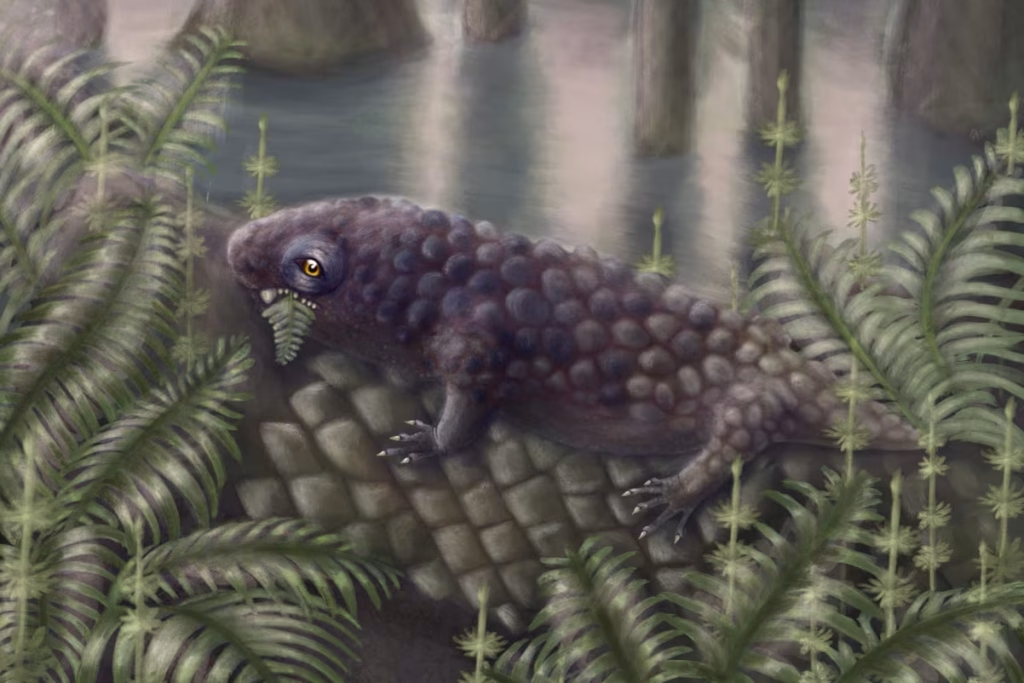
The animal described in the paper, Tyrannoroter heberti, was chunky something like the size and shape of an American football. Its fossils were found in the Sydney Mines Formation on Cape Breton Island, in Nova Scotia, Canada. They date to around 307 – 308 million years ago (Moscovian) nearly the same as Mazon Creek at 307 – 309 million years ago.
Tyrannoroter heberti was a “recumbirostran”, which were a group of small, burrowing tetrapods. It’s represented by a nearly complete skull recovered from a lycopsid tree stump. These fossilized stumps are often found standing upright in the rock. Animals like microsaurs would fall into the hollow centers of dead trees or use them as dens, leading to incredible preservation… a snapshot of the terrestrial animals scurrying around the forest floor.
T. heberti had a roughly triangular shaped skull with specialized teeth arraigned as “dental batteries”, which were essentially a pavement of teeth on both the roof of its mouth (palate) and the inside of its lower jaw. CT scans showed wear patterns consistent with both shearing (cutting) and grinding. This animal wasn’t just catching bugs… it was processing fibrous plant material. Tyrannoroter was found hiding away in the very plants it evolved to eat!

It should be noted that Tyrannoroter isn’t even a ‘true’ reptile yet, but it’s on the lineage leading toward them. This shows that nature ‘invented’ plant-eating almost as soon as animals moved onto land, rather than waiting for reptiles to evolve.
This implies that herbivory arose not during the Permian Period, but during the Late Carboniferous (Pennsylvanian)! Before this discovery, it was often thought that the Carboniferous was dominated by insect-eaters and carnivores. This paper suggests the “herbivore-based foundation” of terrestrial ecosystems, where vertebrates eat plants and then larger vertebrates eat those herbivores, started much earlier and much faster than previously believed.
What is the connection to Mazon Creek? Well, it implies that the Mazon Creek’s diversity of plant life (ferns, lycopsids, etc.) was probably being exploited by specialized vertebrate “shredders”. The ecosystem had a more modern structure than has previously been thought. Now, we just need some fossil evidence from Mazon Creek of these Carboniferous herbivores!
Next time you’re looking through some concretions with “weird, bumpy textures” that don’t look like a typical plant or animal… maybe it’s the palatal teeth of a Mazon Creek version of Tyrannoroter!

Leave a Reply