
-
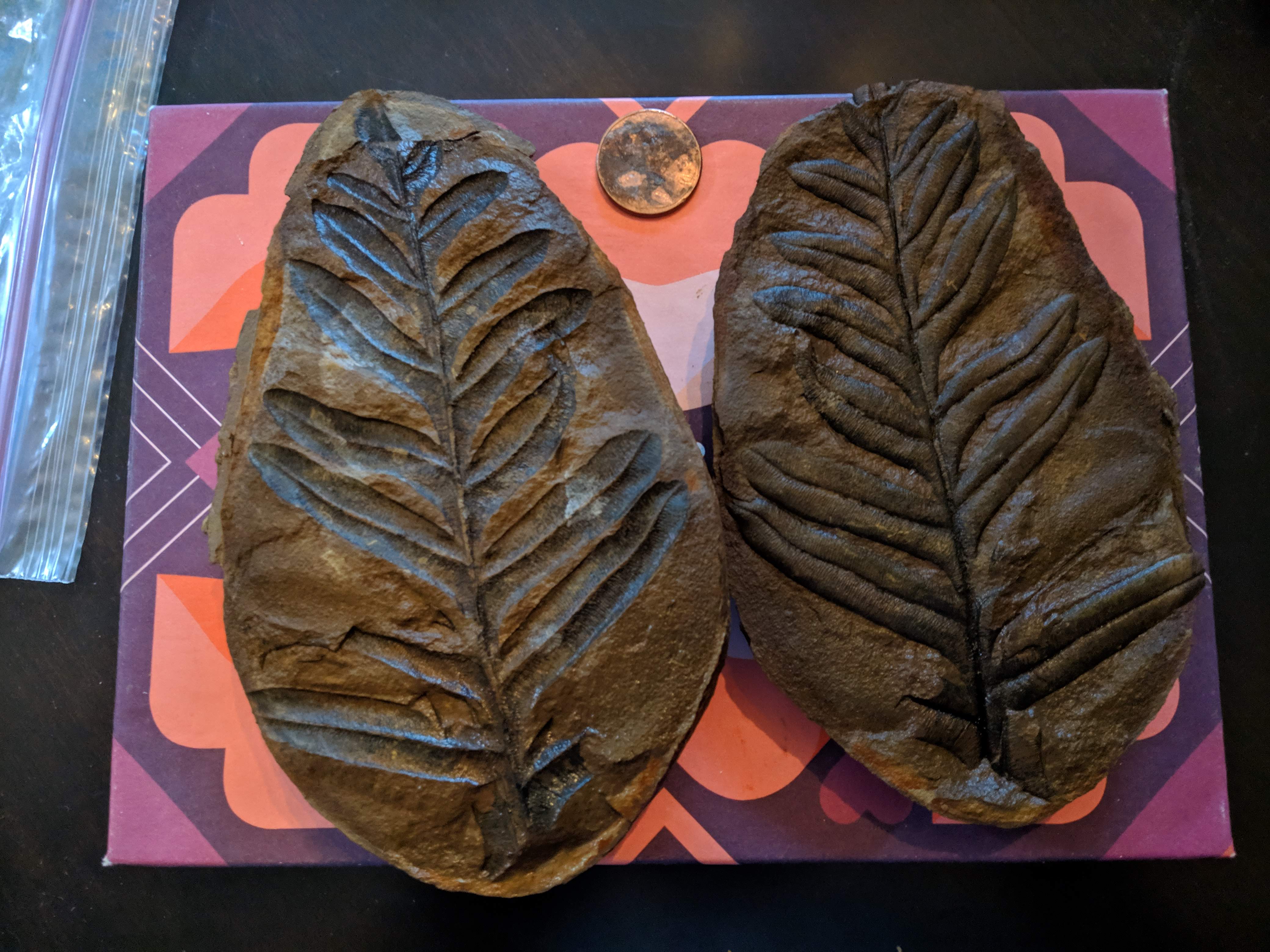
Fossil Friday #9: Alethopteris serlii from the Mazon River
Read more: Fossil Friday #9: Alethopteris serlii from the Mazon RiverThis is the “Fossil Friday” post #9. Expect this to be a somewhat regular feature of the website. We will post any fossil pictures you send in to esconi.info@gmail.com. Please include a short description or story. Check the #FossilFriday Twitter hash tag for contributions from around the world! Here is a stunning Alethopteris serlii from the Mazon River. It was collected in August 2019 and open via freeze/thaw in late September 2019. This plant is among the seed ferns (Pteridospermales), which is an extinct group of gymnosperms.
-
Throwback Thursday #10: What Do You Know About Joliet-Lemont Limestone?
Read more: Throwback Thursday #10: What Do You Know About Joliet-Lemont Limestone?This is Throwback Thursday #10. In these, we look back into the past at ESCONI specifically and Earth Science in general. If you have any contributions, (science, pictures, stories, etc …), please send them to esconi.info@gmail.com. Thanks! The following is an article written by Joseph Kubal, who was President of ESCONI in 2000, serving in other board positions back in the 1990s and 2000s. This article was written in 2013 and has been popular ever since. One Stone to Another By Joseph D. Kubal©2013 Joseph D. Kubal – All Rights Reserved.The information in this article has been excerpted in part…
-

Ticks, Ticks, Ticks, Ticks, Ticks 2020!
Read more: Ticks, Ticks, Ticks, Ticks, Ticks 2020!This post is a little late as we are fast approaching the peak of tick season. But, as the weather gets warmer (and hopefully, dryer), you will probably be spending more time outside looking for fossils, minerals, etc. in the woods, fields, and quarries. One creature you may encounter is a tick. Ticks are arthropods, that unfortunately are vectors for a number of serious diseases. In Illinois, American Dog (Wood), Brown Dog, Lone Star, and Deer ticks are some of the more common species in Illinois. Get a tick removal tool. Here’s the one I’ve used. Here are some resources…
-

Trilobite Tuesday #10: Trilobite Spines
Read more: Trilobite Tuesday #10: Trilobite SpinesThe American Museum of Natural History has a great trilobite website with information and pictures that do a thorough job describing trilobites. Today, we are going to highlight the Trilobite Spines page. From the very beginning of their history up to the end, armor was a big component of trilobite anatomy. First, they had a calcium carbonate exoskeleton, which probably explains why they are preserved in the uncounted billions. At some point, pretty early, some species evolved spines, most likely for defense. It’s easy to imagine they looked less appetizing to the big predators that existed from the Cambrian to the…
-

Mazon Monday #10: Pennsylvanian Siderite Concretionary Fossil Sites
Read more: Mazon Monday #10: Pennsylvanian Siderite Concretionary Fossil SitesThis is Mazon Monday post #10. Fossiliferous Pennsylvanian siderite concretions are known from multiple locations around the world. The most well documented sites are: Some of these localities were described in a paper by Baird, Sroka, and Shabica in 1985, titled “Mazon Creek-Type Fossil Assemblages in the U.S. Midcontinent Pennsylvanian”. A post on the Fossil Forum by user Stocksdale does a good job summarizing these localities with convenient links back in 2014. All of these concretionary deposits occurred in shale layers directly above a coal layer. They contain similar plant and animal fossils with varying degrees of preservation. A quick…
-
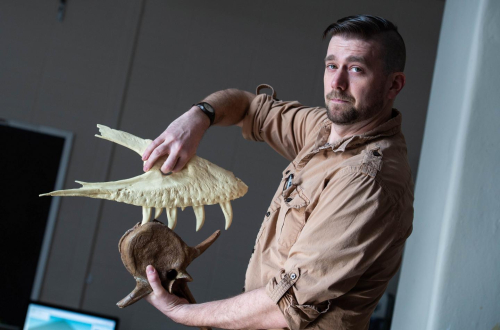
ESCONI June 2020 General Meeting – “Dino-Sores: Injury and Behavior in Cretaceous Dinosaurs” on June 12th, 2020
Read more: ESCONI June 2020 General Meeting – “Dino-Sores: Injury and Behavior in Cretaceous Dinosaurs” on June 12th, 2020We have a remote speaker for our June meeting. He is Dr. Joe Peterson from the University of Wisconsin – Oshkosh. Joe earned a BS Geology at SIU-C and an MS/PhD Geology from NIU. Since, then, he worked and volunteered at Burpee for many years. The title of his program is “Dino-Sores: Injury and Behavior in Cretaceous Dinosaurs”. This meeting will be held over Zoom. Here is the link. If you need help with Zoom, here are some useful Zoom Instructions.
-

PBS Eons: How We Identified One of Earth’s Earliest Animals
Read more: PBS Eons: How We Identified One of Earth’s Earliest AnimalsPBS Eons has a new episode. This one is about the oldest animals that dates back to the Precambrian during the Ediacaran. Scientists had no idea what type of organisms the life forms of the Ediacaran were—lichen, colonies of bacteria, fungi or something else. It turns out, the key to solving the puzzle of Precambrian life was a tiny bit of fossilized fat.
-

Fossil Friday #8: Trilobites from St. Paul Quarry
Read more: Fossil Friday #8: Trilobites from St. Paul QuarryThis is the “Fossil Friday” post #8. Expect this to be a somewhat regular feature of the website. We will post any fossil pictures you send in to esconi.info@gmail.com. Please include a short description or story. Check the #FossilFriday Twitter hash tag for contributions from around the world! —————————————————– Trilobites from the St. Paul Stone Quarry in St. Paul, IN. These photos are from a field trip on October 4th, 2013. Some photos of the quarry… And, now for the trilobites!
-

ESCONI Events June 2020
Read more: ESCONI Events June 2020Field trips require membership, but visitors are welcome at all meetings! Fri, June 12th ESCONI General Meeting 8:00 PM Zoom – Topic: “Dino-Sores: Injury and Behavior in Cretaceous Dinosaurs” by Dr. Joe Peterson from the University of Wisconsin – Oshkosh Zoom meeting link
-

Throwback Thursday #9: Field Trip To Larson Quarry in DeKalb September 19th, 2009
Read more: Throwback Thursday #9: Field Trip To Larson Quarry in DeKalb September 19th, 2009This is Throwback Thursday #9. In these, we look back into the past at ESCONI specifically and Earth Science in general. If you have any contributions, (science, pictures, stories, etc …), please send them to esconi.info@gmail.com. Thanks! ESCONI has had a long history of field trips to the old Elmer Larson (now Vulcan) Quarry in DeKalb, IL. In researching this story, I found this article in the Chicago Tribune from March 27th, 1994 that lists Jack Wittry and others collecting there. There are also articles in various papers of the Open House events they held for years (2007). The abundant…
-

Dinosaur-dooming asteroid struck earth at ‘deadliest possible’ angle
Read more: Dinosaur-dooming asteroid struck earth at ‘deadliest possible’ anglePhys.org has a story about the asteroid that took out the dinosaurs. A study at Imperial College London did simulations and found that the angle of attack for the asteroid that struck the Earth at the end of the Cretaceous Period hit at the “deadliest possible” angle. All the details are in a paper published in the journal Nature Communications. New simulations from Imperial College London have revealed the asteroid that doomed the dinosaurs struck Earth at the ‘deadliest possible’ angle. The simulations show that the asteroid hit Earth at an angle of about 60 degrees, which maximised the amount…
-
Trilobite Tuesday #9: PBS Eons “The Trouble With Trilobites”
Read more: Trilobite Tuesday #9: PBS Eons “The Trouble With Trilobites”The PBS Eons channel on Youtube has new videos about once a week. If you love paleontology or have just a passing interest in paleontology, you will love the videos. https://www.youtube.com/watch?v=Aji2VnQFUCs Enjoy this past episode of PBS Eons. It’s all about the trilobites! Trilobites are famous not just because they were so beautifully functional, or because they happened to preserve so well. They’re known the world over because they were everywhere!
-

Mazon Monday #9: Acanthodes beecheri
Read more: Mazon Monday #9: Acanthodes beecheriThis is Mazon Monday post #9. Acanthodes beecheri is the subject of this Species Spotlight. Some of the material in this post was provided by David Duck. Dave has a deep appreciation and interest in the Mazon Creek fauna and flora. He has even constructed 3-D models of quite a few of the Mazon animals, including the Tullymonster gregarium, Euproops danae, Mamayocaris jaskoskii, and Acanthodes beecheri among others. The models are very detailed! Thanks for your contribution, Dave! Acanthodes is an extinct genus of spiny shark. Fossils have been found in Europe, North America, and Australia. Their geologic range is from…
-
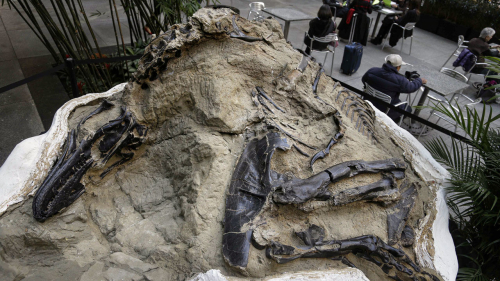
Court rules “Dueling Dinos” belong to landowners, in a win for science
Read more: Court rules “Dueling Dinos” belong to landowners, in a win for scienceScience Magazine has a story about the “Dueling Dinos”. Discovered in 2006, the “Dueling Dinos” is a specimen that consists of two dinosaurs, a ceratopsian and a tyrannosaur, lying next to each other in what seems like mortal combat. Over the last few years, a court battle has tried to determine who owns these priceless fossils. On Wednesday, the Montana Supreme Court ruled that fossil could not be considered as minerals and so the land owner not the mineral rights owner would own this fossil. Quite often in the western United States, different entities own land and mineral rights. A…
-
PBS Eons: The Two Viruses That We’ve Had For Millions of Years
Read more: PBS Eons: The Two Viruses That We’ve Had For Millions of YearsThere’s a new episode of PBS Eons. This one is very relevant… it’s about viruses. In this case, the herpes virus. There’s one kind of herpesvirus that’s specific to one species of primate, and each virus split off from the herpesvirus family tree when the primate split off from its own tree. But of course, humans are a special kind of primate. Here are the two studies we discuss in this episode: Wertheim, J. O., Smith, M. D., Smith, D. M., Scheffler, K., & Kosakovsky Pond, S. L. (2014). Evolutionary origins of human herpes simplex viruses 1 and 2.…
-
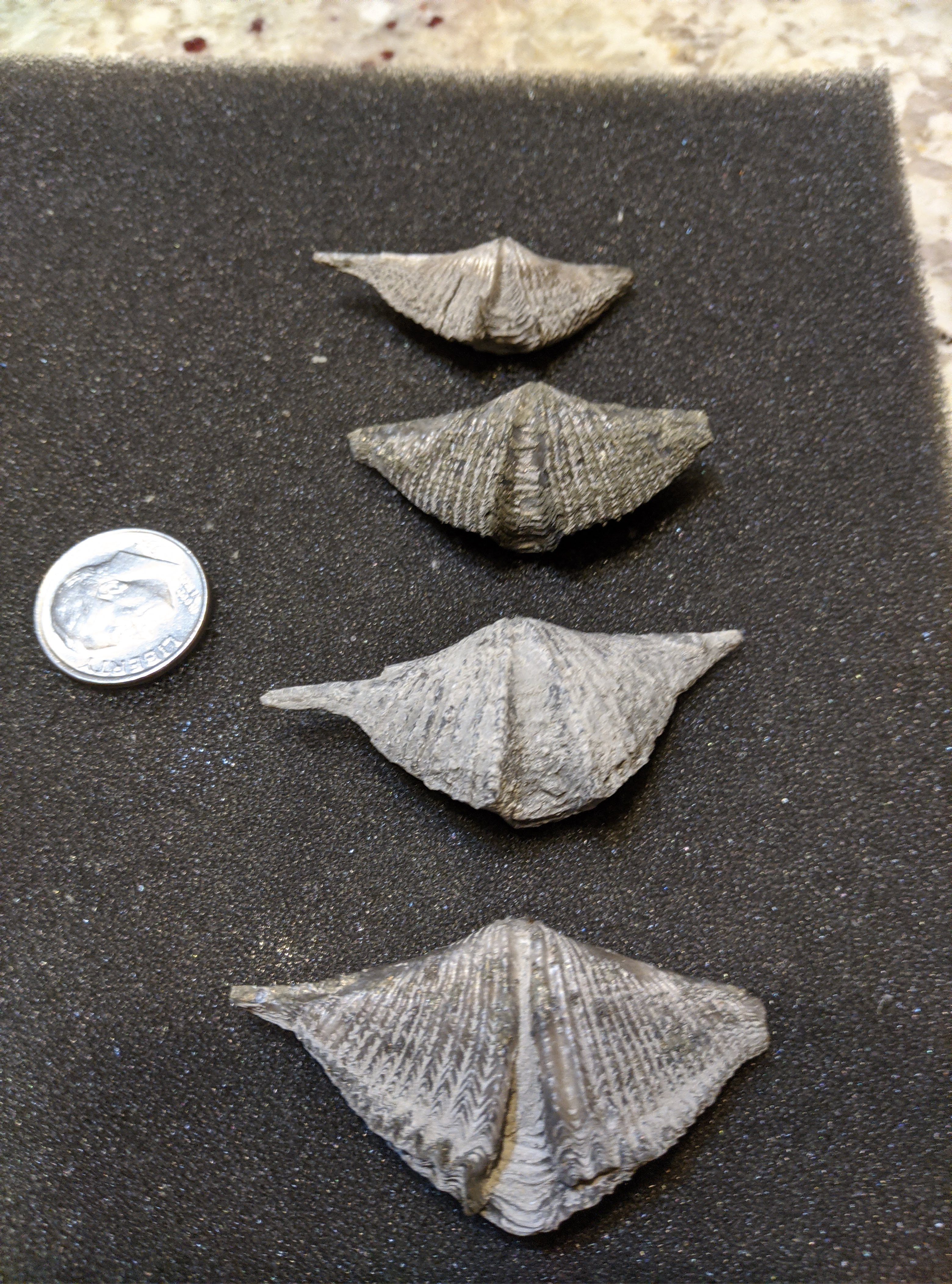
Fossil Friday #7: Brachiopods From The Silica Shale in Ohio
Read more: Fossil Friday #7: Brachiopods From The Silica Shale in OhioThis is the “Fossil Friday” post #7. Expect this to be a somewhat regular feature of the website. We will post any fossil pictures you send in to esconi.info@gmail.com. Please include a short description or story. Check the #FossilFriday Twitter hash tag for contributions from around the world! Today’s fossils for Fossil Friday are brachiopods from the Silica Shale in Ohio. The Silica Shale dates to the Middle Devonian Period about 390 million years ago. During the Devonian, North America occupied a much more southern position on Earth than today. This rock formation is part of the Michigan Basin, which…
-

Happy 221st Birthday, Mary Anning!
Read more: Happy 221st Birthday, Mary Anning!Mary Anning with her dog, Tray, painted before 1842; the Golden Cap outcrop can be seen in the background Mary Anning was born on May, 21st, 1799. She was a fossil collector, dealer, and paleontologist that lived in and around Lyme Regis a city on the South coast of England in the early 19th century. She is most famous for her discoveries of the first correctly identifier ichthyosaur, two of the first complete plesiosaurs, the first pterosaur, Dimorphodon, found outside Germany, and numerous important fish fossils. From her Wikipedia page… Anning searched for fossils in the area’s Blue Lias cliffs, particularly during the winter…
-

Throwback Thursday #8: History on Parade: Grieger’s was lapidary legend
Read more: Throwback Thursday #8: History on Parade: Grieger’s was lapidary legendThis is Throwback Thursday #8. In these, we look back into the past at ESCONI specifically and Earth Science in general. If you have any contributions, (science, pictures, stories, etc …), please send them to esconi.info@gmail.com. Thanks! ——————————————————————————————- Thanks go out to ESCONI member John Liskey as he provided pictures, mineral material, and the idea for this post! Thanks, John! If you collected minerals back in the middle of the 20th century, you were certainly familiar with Grieger’s. That company, founded in 1930 by John Grieger, started as a hobby and it grew into a giant in the mineral world. …
-

New Dinosaur Unearthed in Australia
Read more: New Dinosaur Unearthed in AustraliaSciNews has an article about a new dinosaur discovery in Australia. This new dinosaur lived around 110 million years ago during the Cretaceous Period. It’s a rare type of dinosaur that belongs to the group Elaphrosaurinae, which are odd ceratosaurians known from fossils from Africa, Asia, and Argentina. The fossils were discovered by Dinosaur Dreaming volunteer Jessica Parker in 2015 near Cape Otway, Victoria. All the details can be found in a paper that was published in the journal Gondwana Research. The newly-discovered dinosaur belongs to Elaphrosaurinae, an enigmatic group of gracile ceratosaurian dinosaurs known from the Late Jurassic period of Africa…
-

Trilobite Tuesday #8: Trilobite State Fossils
Read more: Trilobite Tuesday #8: Trilobite State FossilsPlease note: most of the information used here came from the State Fossil page on Fossilera. It has information on all the state fossils, including state dinosaurs and state “stones”. They have nice pictures and a brief description with links for each one. All but seven states have state fossils. There are three types of trilobite that have been honored as state fossils. Those types are listed below. Ohio State Fossil Isotelus Age: OrdovicianYear Designated: 1985 Isotelus is a genus to large Asaphid trilobite that lived during the Ordovician Period. It’s fossils are common within several formations that outcrop in Southwestern Ohio. The largest Isotelus trilobite…

ESCONI Gem, Mineral, and Fossil Show
Most Recent Post
- Throwback Thursday #313: Who Was DuPage? How the River and County Were Named
 The BeHistoric channel on Youtube has a fascinating video about the history behind the name of the DuPage River and DuPage County.
- About ESCONI
- Around the Web
- Calendar of Events
- Code of Ethics and Conduct
- ESCONI Books for Sale
- ESCONI Gem, Mineral, and Fossil Show
- ESCONI in the News
- ESCONI Videos
- Field Trips
- Flashback Friday
- Fossil Friday
- Mazon Creek
- Mazon Monday
- Member Spotlight
- Membership Information
- Reference Material
- Throwback Thursday
- Trilobite Tuesday
Field trips require membership, but visitors are welcome at all meetings!
| Friday, April 10th | General Meeting – 8:00 PM via Zoom. Jessica Hull will present “Life in the Devonian Period, The Age of Fishes.” |
| Saturday, April 11th | Junior Study Group Meeting – 2:00 PM, in person at the College of DuPage Technical Education Center (TEC) Building – Room 1038A (Map). Katherine Howard will present on Sand and Sediment Collecting. Specifics of this meeting are available from Scott Galloway, 630-670-2591, gallowayscottf@gmail.com. |
| Saturday, April 18th | Paleontology Study Group – 7:30 PM via Zoom and in person at the College of DuPage, TEC, Room 1038B (Map). Keith Robitschek will present “Digging the Marl of the Lance Formation.” |
| Friday, April 24th | MAPS Expo XLVII – Springfield, IL. |
| Saturday, April 25th | MAPS Expo XLVII – Springfield, IL. |
| Sunday, April 26th | MAPS Expo XLVII – Springfield, IL. |
| No meeting this month | Mineralogy Study Group |