
-

PBS NOVA: Bigger Than T-Rex… Spinosaurus
Read more: PBS NOVA: Bigger Than T-Rex… SpinosaurusThe Spinosaurus NOVA documentary is over on YouTube. Check it out if you missed it last fall on PBS. There are discussions on the new fossil find in Egypt and the aquatic nature of Spinosaurus, which appeared in an article in the National Geographic Magazine back in September 2014. Enjoy!
-
The Fossil Forum
Read more: The Fossil ForumHave you tried the Fossil Forum? Lots of great information on fossils of all types. There are forums on Fossil Hunting Trips, Fossil ID, Questions & Answers, and Fossil Preparation. The monthly Fossil of the Month is always amazing. Fossil Sites is a useful resource to find new places to hunt, either locally or when you are on vacation. Check it out this winter for great discussion with a bunch of good and helpful people of like mind.
-
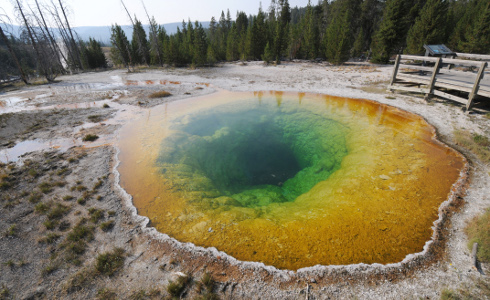
Science Friday: Picture of the Week
Read more: Science Friday: Picture of the WeekMorning Glory thermal spring, in Yellowstone National Park (photo taken in August 2012). Credit: Joseph Shaw, Montana State University Science Friday’s Picture of the Week is of the Morning Glory thermal spring, in Yellowstone National Park. It hasn’t always had the colors you see today. Scientists used biological, chemical, and optical data to construct a mathematical model of how the spring has changed over time. Tourists have been tossing coins, rocks, and other debris into it for decades. That debris has partially blocked the underground heat source and lowered the temperature. Now, the spring is home to photosynthetic microorganisms that probably…
-
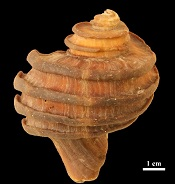
15 Million Year Old Proteins Recovered From Mollusk Shell
Read more: 15 Million Year Old Proteins Recovered From Mollusk ShellA group of scientists from the Carnegie Institution have recovered proteins from a 15 million year of gastropod shell from the Calvert Cliffs of southern Maryland. The team, which included John Nance, John Armstrong, George Cody, Marilyn Fogel, and Robert Hazen, collected fossil Ecphora shells from a popular collecting site along the shoreline of the Chesapeake Bay. The original paper was published in the inaugural issue of the Geochemical Perspectives Letters. Ecphora is known for an unusual reddish-brown shell color, making it one of the most distinctive North American mollusks of its era. This coloration is preserved in fossilized remains, unlike the…
-
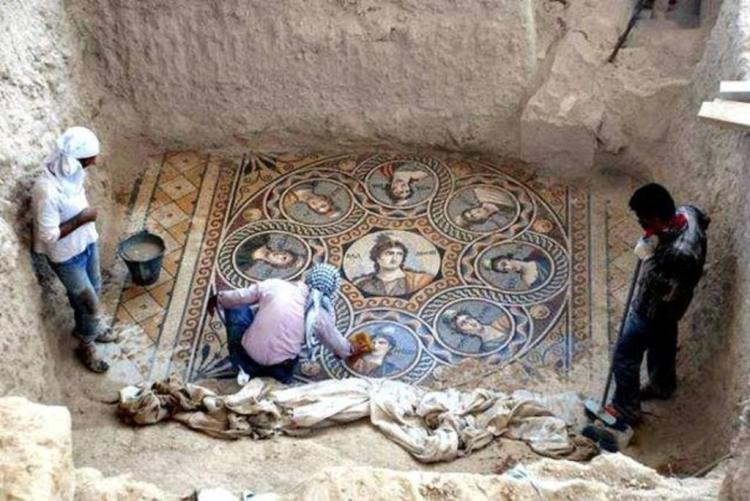
Stunning 2200-Year-Old Mosaics Discovered in Ancient Greek City
Read more: Stunning 2200-Year-Old Mosaics Discovered in Ancient Greek CityLaughing Squid has a story about some amazing ancient Greek mosaics. They were discovered in the Turkish city of Zeugma. The artwork, which dates to the 2nd century BCE, is constructed of boldly colored glass. Up until 2000, the ancient city was completely submerged underwater. There are many areas of Zeugma, once home to about 80,000 people, left to excavate. From now on, we will work on restoration and conservation. We plan to establish a temporary roof for long-term protection. We estimate that the ancient city has 2,000-3,000 houses. Twenty-five of them remain under water. Excavations will be finished in…
-
Why an Ichthyosaur Looks Like a Dolphin
Read more: Why an Ichthyosaur Looks Like a DolphinHow skull (top) and tooth (bottom) shapes group marine tetrapods together. From Kelley and Motani, 2015. Brian Switek has an interesting post on his Laelaps blog over at National Geographic. In it, he discusses a new Biology Letters study by marine tetrapod specialists Neil Kelley and Ryosuke Motani. They compared the skulls and teeth of marine tetrapods from many animals, including whales, turtles, crocodiles, seals, and even our friends the sauropterygians (plesiosaurs, pliosaurs, mosasaurs, and ichthyosaurs). What they found is that form followed function. Skull anatomy is a fairly good predictor of feeding strategy regardless of ancestry. Nice results that…
-
(broken link) A Bundle of Brachiopods – Zygospira
Read more: (broken link) A Bundle of Brachiopods – ZygospiraSpring can’t be too far off, as it sounds like our southern Indiana (and Ohio) neighbours are already out fossil hunting (did they ever stop?). This story over at Ordovician Weekly is about some Zygospira brachiopods. Many of you are familiar with these little guys from the “butter shale” off Route 1 near St. Leon, IN.
-

CBC Quirks & Quarks Pterosaurs
Read more: CBC Quirks & Quarks PterosaursModel of Quetzalcoatlus, the largest known Pterosaur (Alina Zienowicz, cc-by-sa-3.0) CBC Quirks & Quarks has a story about the largest pterosaurs, more specifically, how they flew. Quetzalcoatlus is the largest known pterosaur. It had a wingspan of more that 10 meters. That’s larger than many small planes! Dr. Michael Habib, an assistant professor at the University of Southern California in Los Angeles, studied the physics of their flight, the limits on their size, and just how big they could get. The quick answer, they could get even bigger! In engineering simulations, he found that for flight and landing they could…
-
Rare Coins From the 1600s Found in Pennsylvannia
Read more: Rare Coins From the 1600s Found in PennsylvanniaYahoo has a story of a treasure find. Coins from the 1600s were discovered on the property of the historic home of Patrick Gass in Chambersburg, Franklin County, PA. Gass served as a sergeant on the Lewis and Clark Expedition (1804-1806).
-
Rare mineral found in a Wisconsin crater
Read more: Rare mineral found in a Wisconsin craterPhys.Org has a story about the discovery of one of the Earth’s rarest minerals. The mineral reidite was found in samples from an impact site in Rock Elm, Wisconsin. Rock Elm is just the fourth site on Earth where the mineral has been found. The Rock Elm structure dates to the Middle Ordovician, about 450 million year ago. Aaron Cavosie of the University of Puerto Rico, and member of the NASA Astrobiology Institute Team at the University of Wisconsin, brought students to an impact site in Rock Elm, Wisconsin to collect samples. In those samples, Cavosie and colleagues discovered the…
-
Resources on Google Books
Read more: Resources on Google BooksLooking for reading material this winter? Researching fossils and artefacts in your collection? Check out Google Books or Google Scholar. There is a huge amount of material online just waiting to be consumed. Below you will find just a few of the books to be found; many of them are free. You can even download PDFs for some. Happy reading! Mazon Creek Fossils, edited by Matthew H. Nitecki Fossils, The Key to the Past, by Richard Fortey The Bone Sharp, The Life of Edward Drinker Cope, by Jane P Davidson Grave Secrets of Dinosaurs, by Phillip Manning The Life of a…
-
Bad Luck Rocks?
Read more: Bad Luck Rocks?Legend has it, you will have bad luck if you take rocks from Arizona’s Petrified Forest National Park. The NYT has a story about people that steal and then return their booty to the park. There’s a nice slide show of some of the returned pieces. They are interesting specimens, so it’s not too surprising they were pocketed. “Bad Luck, Hot Rocks,” a book edited by the artists Ryan Thompson and Phil Orr and published in November by The Ice Plant, documents more than fifty specimens from the conscience pile, along with some of the letters of apology that accompanied…
-
Humans and Neanderthals Were Neighbors
Read more: Humans and Neanderthals Were NeighborsNature has a story of the recent discovery of a cranium which shows that modern humans Homo sapiens were living in the Middle East 55,000 years ago. The skull bone was found when a cave, which had been sealed for the last 15,000 years, was opened by a bulldozer clearing land for development near the Sea of Galilee in northern Israel. Amateur speleologists were the first to search the cave, and they spotted the battered bone on a rock ledge. The Israel Antiquities Authority launched a complete survey and found other artifacts including stone tools. Parts of the cave are still…
-
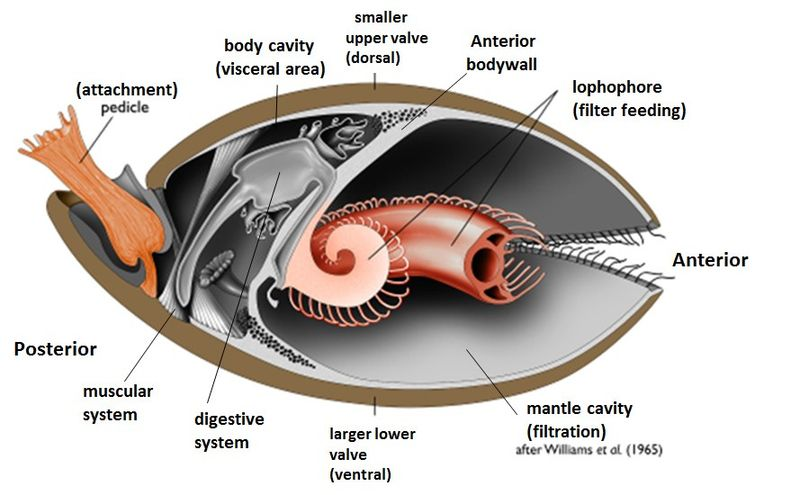
Palaeocast #40: Brachiopods
Read more: Palaeocast #40: BrachiopodsIf you’re stuck inside with all the snow (at least in the mid west). Check out the new episode of Palaeocast. It’s part 1 of a podcast on Brachiopods. There’s quite a bit of good information about current species, their history, and anatomy. And, some talk about what happened to them at the end of the Paleozoic.
-

ESCONI Events February 2015
Read more: ESCONI Events February 2015Fri, Feb. 13 ESCONI General Meeting 8:00 p.m. College of Dupage, – Tech Ed (TEC) Building, Room 1038B (Map) – Topic:“The Human Paradox: Friendship and Violence in EvolutionaryPerspective.” by Dr. John Terrell, Anthropologist and Curator,Field Museum Sat, Feb. 14 ESCONI Mineralogy Meeting 7:30 p.m. College of Dupage, – Tech Ed (TEC) Building, Room 1038B (Map) – Topic: “Nevada”, ESCONI member Jim Daly will speak about the Silver Coin Mine, Valmy, NV. Others will discuss the Meikle Goldstrike Mine in Carlin Trend. Fri, Feb. 20 ESCONI Archaeology Study Group Meeting. 7:30 p.m. College of Dupage, – Tech Ed Building (TEC), Room 1038B (Map) -Topic: “Asian Influence in Ancient Petroglyphs”,…
-
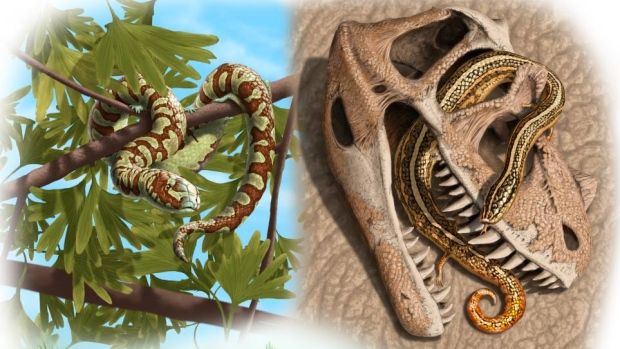
CBC Quirks & Quarks Oldest Known Snake Fossils
Read more: CBC Quirks & Quarks Oldest Known Snake FossilsArtist’s conception of two of the ancient snakes. (Julius Csotonyi) The January 31st, 2015 edition of Quirks & Quarks has a story on the oldest known snake fossils. The four new fossil specimens were found in various places, two in England and one each in Portugal and Colorado (in the US). Originally thought to be lizards, new research shows all four represent new species with ages ranging from 143 to 167 million years ago. That pushes back the oldest snake by an astounding 70 million years! The original paper from Nature Communications can be found here.
-
Fossil Friday: Find the Trilobite
Read more: Fossil Friday: Find the TrilobiteHere's a little puzzle… find the trilobite. It's a small enrolled Ditomopyge from the Permian of Kansas.
-
Etymology of Species Names
Read more: Etymology of Species NamesMany of us know that the greek and latin languages are the basis of many species names. To decode them into their meaning, use these pages: List of Greek and Latin roots and Latin and Greek words commonly used in systematic names Some examples: Triceratops, Tri (three), cera (horn), ops (eye, face), three horned face Tyrannosaurus, Tyranno (absolute ruler, tyrant) saurus (lizard), tyrant lizard Dimetrodon, Di (two), metro (measures), don (dont, tooth), two types of teeth Try it yourself for “Dinosaur”, “Pteradactyl”, “Trilobite”, and “Pecopteris”.
-

CBC Quirks & Quarks On Potential Tool Usage By Australopithecus
Read more: CBC Quirks & Quarks On Potential Tool Usage By AustralopithecusQuirks & Quarks has a story in their January 24th, 2015 podcast on Australopithecus africanus and potential tool usage. By studing the structure of hand bones, it has been determined that A. africanus had sufficient grip strength to use tools. The study looked at the structure of the inner trabecular bone. The earliest known use of stone tools is from 2.6 million years ago. They were made by a species of hominin known as Homo habilis. Making stone tools and using them is only possible with the capability to make a precision grip with an opposable thumb. Human hands have that…
-
The 25 Biggest Turning Points in Earth’s History
Read more: The 25 Biggest Turning Points in Earth’s HistoryBBCearth has a cool page called The 25 Biggest Turning Points in Earth’s History. The list includes events like the formation of the Earth, the great oxidation event, the “Cambrian Explosion”, and various mass extinction events like the “Great Dying” and extinction of the non-avian dinosaurs. It’s well done and includes estimates on when the events happened. There’s a bunch of good content over at BBCearth.

ESCONI Gem, Mineral, and Fossil Show
Most Recent Post
- PBS Eons: The Second-to-Last Mammoths Ever
 PBS Eons has a new episode. This one is about some of the last Mammoths on Earth.
- About ESCONI
- Around the Web
- Calendar of Events
- Code of Ethics and Conduct
- ESCONI Books for Sale
- ESCONI Gem, Mineral, and Fossil Show
- ESCONI in the News
- ESCONI Videos
- Field Trips
- Flashback Friday
- Fossil Friday
- Mazon Creek
- Mazon Monday
- Member Spotlight
- Membership Information
- Reference Material
- Throwback Thursday
- Trilobite Tuesday
Field trips require membership, but visitors are welcome at all meetings!
| Friday, May 2nd | Field Trip to Danville, IL. Details here. |
| Friday, May 8th | General Meeting – 8:00 PM via Zoom. Thomas Loebel will present “Seeing Beneath the Ground: Geophysics and Archaeological Explorations in Illinois”. |
| Saturday, May 9th | Junior Study Group Meeting – 2:00 PM, in person at the College of DuPage Technical Education Center (TEC) Building – Room 1038A (Map). “The Rock Cycle and Sedimentation” Specifics of this meeting are available from Scott Galloway, 630-670-2591, gallowayscottf@gmail.com. |
| Saturday, May 16th | Paleontology Study Group – 7:30 PM via Zoom. John Catalani will present “An Ordovician Konzentrat Lagerstätte: The Dixon Mifflin Residuum Fauna”. |
| Saturday, May 23rd | CGMA Show, Kane County Fairgrounds |
| Sunday, May 24th | CGMA Show, Kane County Fairgrounds |
| Saturday, May 30th | Field Trip to Braceville, IL. Details here. |
| Sunday, May 31st | Field Trip to Braceville, IL. Details here. |
| No meeting this month | Mineralogy Study Group |