
-
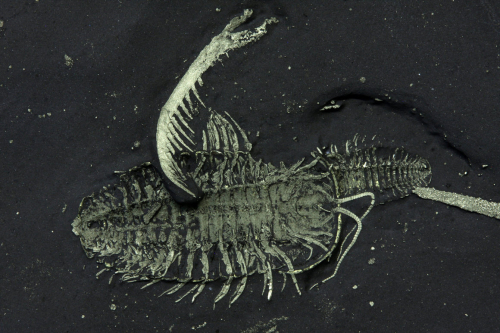
In Upstate New York, Ancient Arthropods Can Get Turned Into (Fool’s) Gold
Read more: In Upstate New York, Ancient Arthropods Can Get Turned Into (Fool’s) GoldAtlas Obscura has a piece about trilobites… golden trilobites. Trilobites are some of the most desirable fossils and highly detailed, pyritized trilobites are especially desirable. “Beecher’s Bed” is a famous trilobite quarry discovered and named for Charles Emerson Beecher, a paleontologist a the Peabody Museum of Natural History at Yale University. It is made of good old Ordovician shale and loaded with stunning trilobite specimens, all preserved in golden pyrite. First excavated in 1893, it was lost in 1904 after Beecher’s untimely death, because he never recorded the location. It was found again in 1982. Markus Martin took over the…
-

800,000 Years Ago, a Meteor Slammed Into Earth. Scientists Just Found the Crater
Read more: 800,000 Years Ago, a Meteor Slammed Into Earth. Scientists Just Found the CraterLiveScience has a story about a century long search to find a meteor crater. About 790,000 years ago, a meteor hit the Earth and spread tektites, shiny black lumps of rock, over about 10% of the surface of the planet. The tektites were found from Indonesia to eastern Antarctica and from the Indian Ocean to the western Pacific Ocean. Now, scientists from the Jackson School Museum of Earth History at the University of Texas have published a paper in the journal Proceedings of the National Academy of Sciences, in which, they claim to have found the crater. Geochemical analysis and…
-
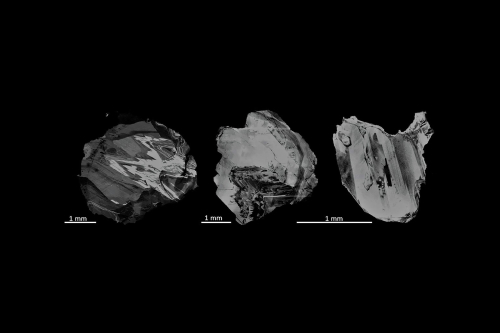
Reminder: ESCONI January 2020 General Meeting Michelle Wenz – “Earth’s Inner Workings Revealed through Mineral Inclusions in Diamond” on January 10, 2020
Read more: Reminder: ESCONI January 2020 General Meeting Michelle Wenz – “Earth’s Inner Workings Revealed through Mineral Inclusions in Diamond” on January 10, 2020Electron microscope images of diamonds from the Juína area of Brazil.Credit…Suzette Timmerman The speaker at our January 10, 2020 meeting will be Michelle Wenz, a PhD student from Northwestern University. The title of her talk is “Earth’s Inner Workings Revealed through Mineral Inclusions in Diamond”. She is working on an suite of superdeep diamonds from Juina, Brazil, many of which appear to have come from the 400-700 km depth range. Her research focus is on water, and deep-mantle water cycling. She developed a method using synchrotron radiation (X-rays) from the Advanced Photon Source at Argonne to image tomographically the location…
-

ESCONI January 2020 Junior Meeting – Does your child like earth science books? on January 10, 2020
Read more: ESCONI January 2020 Junior Meeting – Does your child like earth science books? on January 10, 2020Does your child like earth science books? Bring them to our next junior meeting and we will use picture books to identify rocks & minerals! Ages 6 to 17 are welcome. Friday January 10, 2020 at 7pm College of DuPage Technical Education Center West side room 1038A Contact gallowayscottf@gmail.com with questions Go to www.ESCONI.org for the map.
-
Happy Perihelion Day 2020! Earth Is Closest to the Sun Today
Read more: Happy Perihelion Day 2020! Earth Is Closest to the Sun TodayAn illustration of perihelion and aphelion in the Earth's orbit around the sun, as well as the moon's apogee and perigee in its orbit around planet Earth. (Image credit: NASA) Today is Perihelion Day! We are at our closest approach to the sun… checkout all the details over on Space.com. Unfortunately, we are still in Winter, but the days have been getting longer since the Winter Solstice. It won't be long before spring is here and we'll all be out collecting fossils again! At the time of perihelion, Earth is about 91,398,199 miles (147,091,144 kilometers) away from the sun. On average, Earth's…
-
Rescheduled Warehouse Work Day Due to Weather – Saturday, January 25th, 2020, 9:00 – 1:00ish
Read more: Rescheduled Warehouse Work Day Due to Weather – Saturday, January 25th, 2020, 9:00 – 1:00ishIf you have some time, come join our work day at the warehouse on Saturday, January 25th, 2020 from 9:00-1:00ish. If the weather is bad, we will choose a different day and let everyone know. The warehouse address is 900 Knell in Montgomery, IL. Please meet/enter in the back of the warehouse ONLY. You will see railroad tracks along the back of the warehouse. Drive all the way to the end in the back. For more information, contact us at esconi.info@gmail.com
-

Teenage T. Rex Fossils Reveal Haphazard Growth Spurts
Read more: Teenage T. Rex Fossils Reveal Haphazard Growth SpurtsSmithsonian Magazine has an article about teenage T. rex fossils. The article discusses a recent paper that appeared in Science Advances. That paper readdresses the two sleek, and slender tyrannosaurs, nicknamed Jane and Petey, at the Burpee Museum of Natural History in Rockford, Illinois and concludes that the two specimens are juvenile T. rexes, not Nanotyrannus as was previously published. Maxing out around 40 feet in length and up to 9 tons in weight, adult T. rex were a force to be reckoned with. But the most well-studied T. rex fossils have also been the biggest—adults that had wrapped up most of the growing process…
-

ESCONI Flashback Friday #34: Pictures From a Fossil Field Trip To Indiana May 4-5, 1957
Read more: ESCONI Flashback Friday #34: Pictures From a Fossil Field Trip To Indiana May 4-5, 1957As part of the celebration of ESCONI’s 70th Anniversary, here is Flashback Friday post #34. If you have pictures or stories to contribute, please send them over to esconi.info@gmail.com. Thanks! Here are some pictures from a field trip to a few localities in Indiana May 4-5, 1957. No hard hats and check out those clothes! Indiana Paleontology trip – Allaway, M.Balbitt, H.Bonow Stoney Creek Motel in Bloomington briefing for Madison, Ind Highway near Bloomington, Indiana Bloomington-Nashville road crinoids Spencer, Indiana Helen Law Indiana quarry Betty Farr & Mary Fitly
-

ESCONI Events January 2020
Read more: ESCONI Events January 2020Field trips require membership, but visitors are welcome at all meetings! Fri, Jan 10th ESCONI Junior Meeting, 7:00 PM College of Dupage – Tech Ed (TEC) Building, Room 1038A (Map) – Topic: “Does your child like earth science books?” Fri, Jan 10th ESCONI General Meeting, 8:00 PM College of Dupage – Tech Ed (TEC) Building, Room 1038A (Map) – Topic: “Earth’s Inner Workings Revealed through Mineral Inclusions in Diamond” by Michelle Wenz, Researcher at Northwestern University Sat, Jan 18th ESCONI Paleontology Study Group Meeting, 7:30 PM –Tech Ed (TEC) Building, Room 1038B (Map) – Topic: “Middle Cambrian Fossils of Utah” by…
-

Man Keeps Rock For Years, Hoping It’s Gold. It Turned Out to Be Far More Valuable #meteorite
Read more: Man Keeps Rock For Years, Hoping It’s Gold. It Turned Out to Be Far More Valuable #meteoriteScienceAlert has a post about a valuable find in Australia. It seems that David Hole found a rock he hoped would be gold. It wasn’t, but as it turns out it was more valuable than gold! In 2015, David Hole was prospecting in Maryborough Regional Park near Melbourne, Australia. Armed with a metal detector, he discovered something out of the ordinary – a very heavy, reddish rock resting in some yellow clay. He took it home and tried everything to open it, sure that there was a gold nugget inside the rock – after all, Maryborough is in the Goldfields…
-
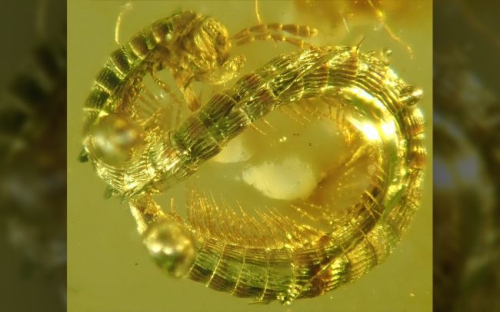
LiveScience: The 100 Best Science Photos of 2019
Read more: LiveScience: The 100 Best Science Photos of 2019Live Science has an interesting post, which includes 100 awesome science photos from 2019. Check it out… a great way to relax on New Years Day! Happy New Year from us at ESCONI! About 99 million years ago, a Cretaceous millipede scampered over the forest floor in what is now Southeast Asia, avoiding being squished by neighboring dinosaurs. But the millipede, now called Burmanopetalum inexpectatum, did stumble into a sticky patch of sap, said researchers who found the tiny corpse entombed in the hardened form of that sap called amber.
-

SciNews: 305-Million-Year-Old Fossil Shows Parent Caring for Its Offspring
Read more: SciNews: 305-Million-Year-Old Fossil Shows Parent Caring for Its OffspringSciNews has a piece about an ancient synapsid with evidence that it cared for its young. The animal, called Dendromaia unamakiensis, lived about 305 million years ago in what is now Cape Breton Island, Nova Scotia. This find consists of both an adult and an associated juvenile which were found inside a fossilized tree stump. Evidence of behavior is rare in the fossil record, which is why this is a such a valuable find. The details of the discovery was published in a paper in the journal Nature Ecology & Evolution. “Parental care is a behavioral strategy where parents make…
-
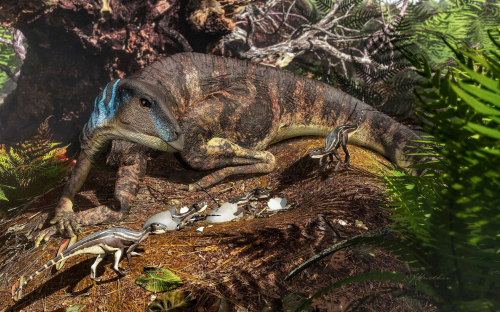
SciNews: Paleontologists Uncover Fossilized Remains of Baby Ornithopod Dinosaurs in Australia
Read more: SciNews: Paleontologists Uncover Fossilized Remains of Baby Ornithopod Dinosaurs in AustraliaSciNews has a story about the fossils of baby Ornithopod dinosaurs discovered in Australia. The animals are baby Weewarrasaurus pobeni dinosaurs, that lived about 100 million years ago during the middle Cretaceous period. Southeastern Australia, where these dinosaurs lived, was much closer to the South Pole at the time. These specimens reveal important insights into high-latitude breeding in Gondwana. A recent paper in journal Scientific Reports has all the details. The newly studied fossils belong to a species of small-bodied ornithopod dinosaur very similar to Weewarrasaurus pobeni. To estimate the individuals’ age, the researchers used growth rings in the dinosaur bones,…
-

FOSSIL Project Fall 2019 Newsletter
Read more: FOSSIL Project Fall 2019 NewsletterVolume 6, Issue 3, Fall 2019| FOSSIL Project Newsletter Fall 2019
-
NatGeo: Earth has had more major mass extinctions than we realized
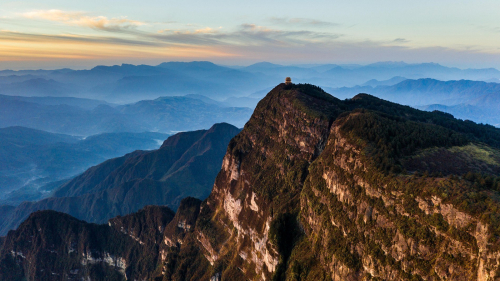
Read more: NatGeo: Earth has had more major mass extinctions than we realizedNational Geographic has a story about Earth’s mass extinctions. The current biodiversity crisis is usually referred to as the “sixth mass extinction”. There is even a book by that name. Of the five previous extinctions, the worst was the one at the end of the Permian. In a paper in the journal Historical Biology, Michael Rampino and Shu-Zhong Shen argue that the end-Guadapulian extinction, which occurred 259 million years ago in the middle Permian, should be considered a major extinction event. In 1982, quantitative paleontologists Jack Sepkoski and David Raup at the University of Chicago took stock of the Earth’s…
-
ESCONI Flashback Friday #33: Plant Life Through The Ages
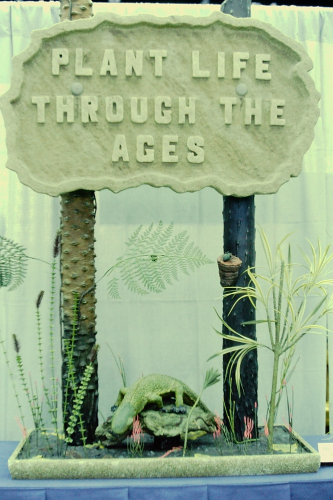
Read more: ESCONI Flashback Friday #33: Plant Life Through The AgesAs part of the celebration of ESCONI’s 70th Anniversary, here is Flashback Friday post #33. If you have pictures or stories to contribute, please send them over to esconi.info@gmail.com. Thanks! The “Plant Life Through The Ages” display was created by ESCONI members during the 1950s. Here is a description from Kathy Dedina, who was president of ESCONI during the 1990s. “In 1964 Plant Life Through the Ages as exhibited for the first time at the Midwest Federation convention in Muskegon Michigan. Models of early plant life were created by members of the paleontology study group which was formed in 1954.…
-
365-Million-Year-Old Lungfish Unearthed in South Africa
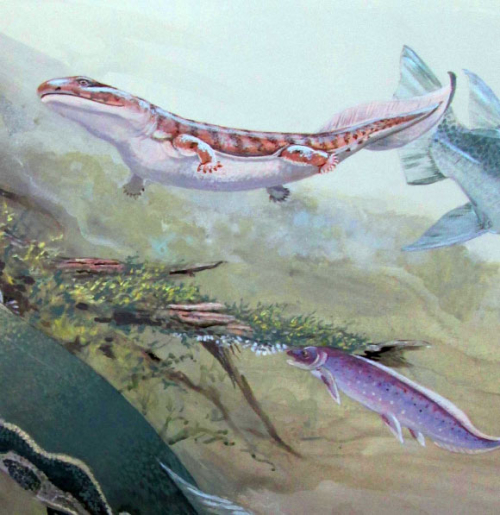
Read more: 365-Million-Year-Old Lungfish Unearthed in South AfricaSci-News has a story about a recently discovered Lungfish from South Africa. The new fish, called Isityumzi mlomomde, lived about 365 million years ago during the Devonian period in what is now modern day South Africa. Lungfish origins stretch back about 410 million years ago to the early Devonian. Details on this new find can be found in a paper published in the journal PeerJ. Lungfish (subclass Dipnoi) are a group of lobe-finned fish with their origins stretching back to the Early Devonian period, over 410 million years ago. They reached a peak of diversity and abundance throughout the Devonian with close to…
-

A ‘Jackalope’ of an ancient spider fossil deemed a hoax, unmasked as a crayfish
Read more: A ‘Jackalope’ of an ancient spider fossil deemed a hoax, unmasked as a crayfishPhys.org has a post about a crayfish masquerading as a spider. It seems someone painted legs on a poorly preserved crayfish fossil from the Lower Cretaceous Yixian Formation of China. You can read about their detective work in a paper published in the journal Paleoentomology. The locals sold the fossil to scientists at the Dalian Natural History Museum in Liaoning, China, who published a description of the fossil species in Acta Geologica Sinica, the peer-reviewed journal of the Geological Society of China. The Chinese team gave the spider the scientific name Mongolarachne chaoyangensis. But other scientists in Beijing, upon seeing the paper,…
-

In Defense of Plants: The Rise and Fall of the Scale Trees
Read more: In Defense of Plants: The Rise and Fall of the Scale TreesI recently ran into an interesting post on the blog “In Defense of Plants”. It’s called “The Rise and Fall of the Scale Trees”. If you collect or are familiar with Mazon Creek fossils, you probably have heard of Lepidodendron, Stigmaria, Psaronius, Cyperites. etc. You might even have a few of these fossils. Some of these are the species name for a plant part or even the name that denotes the whole specimen. Fossil plants are usually fragmentary and separate parts were given different names. As more fossils are found, associated parts help paleobotanists assemble whole plants. This post does…

ESCONI Gem, Mineral, and Fossil Show
Most Recent Post
- Video for ESCONI April 2026 General Meeting – “Life in the Devonian Period, The Age of Fishes”
 The April 2026 General Meeting was held on April 10th, 2026 at 8:00 via Zoom. At the meeting, Jessica Hull presented “Life in the Devonian Period, The Age of Fishes.”
- About ESCONI
- Around the Web
- Calendar of Events
- Code of Ethics and Conduct
- ESCONI Books for Sale
- ESCONI Gem, Mineral, and Fossil Show
- ESCONI in the News
- ESCONI Videos
- Field Trips
- Flashback Friday
- Fossil Friday
- Mazon Creek
- Mazon Monday
- Member Spotlight
- Membership Information
- Reference Material
- Throwback Thursday
- Trilobite Tuesday
Field trips require membership, but visitors are welcome at all meetings!
| Friday, April 10th | General Meeting – 8:00 PM via Zoom. Jessica Hull will present “Life in the Devonian Period, The Age of Fishes.” |
| Saturday, April 11th | Junior Study Group Meeting – 2:00 PM, in person at the College of DuPage Technical Education Center (TEC) Building – Room 1038A (Map). Katherine Howard will present on Sand and Sediment Collecting. Specifics of this meeting are available from Scott Galloway, 630-670-2591, gallowayscottf@gmail.com. |
| Saturday, April 18th | Paleontology Study Group – 7:30 PM via Zoom and in person at the College of DuPage, TEC, Room 1038B (Map). Keith Robitschek will present “Digging the Marl of the Lance Formation.” |
| Friday, April 24th | MAPS Expo XLVII – Springfield, IL. |
| Saturday, April 25th | MAPS Expo XLVII – Springfield, IL. |
| Sunday, April 26th | MAPS Expo XLVII – Springfield, IL. |
| No meeting this month | Mineralogy Study Group |