-
The American Museum of Natural History Plans an Addition
Read more: The American Museum of Natural History Plans an AdditionThe American Museum of Natural History is expanding. The American Museum of Natural History, a sprawling hodgepodge of a complex occupying nearly four city blocks, is planning another major transformation, this time along Columbus Avenue: a $325 million, six-story addition designed to foster the institution’s expanding role as a center for scientific research and education. Story in the NY Times here.
-
ZRS Moroccan Field Trip
Read more: ZRS Moroccan Field TripOur friends over at ZRS Fossils are working on another field trip to Morocco. This will be the 5th annual trip. Here are the details: Sounds like a amazing adventure!
-

A Paleo Reader: 22 Books for Fossil Lovers
Read more: A Paleo Reader: 22 Books for Fossil LoversGood story over on the NMNH blog. Many good books listed. Here’s just a few highlights: If you’ve got some time over the holidays (or the upcoming cold months), grab some good reading!
-
Carboniferous Fish With Color Vision
Read more: Carboniferous Fish With Color VisionAn acanthodian fish from the Hamilton formation (Upper Carboniferous, ~300 MY old) of Kansas is described with cellular details of the eye and possibly eumelanin (a pigment molecule) preserved. This is another instance of morphological preservation of soft tissue, and maybe molecular preservation. Article in Science Times at: http://www.sciencetimes.com/articles/2179/20141225/cones-rods-fossilized-in-ancient-fish-eyes-what-they-tell-us-about-the-view-from-the-past.htm Abstract in Nature Communications at: http://www.nature.com/ncomms/2014/141223/ncomms6920/full/ncomms6920.html
-
Tyrannosaurid Dinos of Canada Were Pack Hunters according to Trackways
Read more: Tyrannosaurid Dinos of Canada Were Pack Hunters according to TrackwaysWorld’s first trackways attributed to tyrannosaurid dinosaurs of Canada strongly suggest that some were pack hunters. Here’s a good summary. In 2011, a local hunting outfitter and guide, Aaron Fredlund, unearthed two tyrannosaur track marks in the foothills of the Canadian Rockies in British Columbia and then told McCrea’s team about the discovery. The team eventually discovered a patch 197 feet (60 meters) long by 13 feet (4 m) wide filled with footprints from multiple dinosaurs, including tyrannosaurs, other small theropods, and duck-billed dinosaurs called hadrosaurs. These dinosaurs were apparently walking in the silty sediments from an overflowing river and…
-
The FOSSIL Project eNewsletter Volume 1, Issue 4
Read more: The FOSSIL Project eNewsletter Volume 1, Issue 4The next issue of the FOSSIL Project eNewsletter is here. Get it (or subscribe) here. Their website is at http://www.myfossil.org/, find them on Facebook at TheFossilProject, or on Twitter at @projectFOSSIL.
-
Jack Horner’s Chickenosaurus
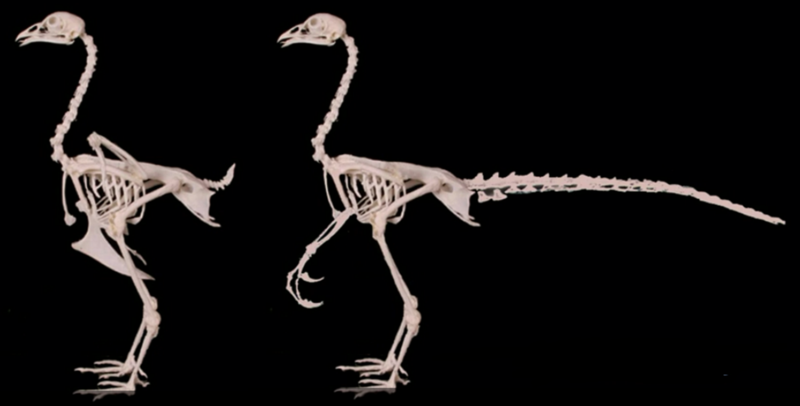
Read more: Jack Horner’s ChickenosaurusBack in 2009 Jack Horner said in a 60 Minutes interview that he wanted to make a “chickenosaurus” within 5 years (a chickenosaurus being a chicken which has been genetically manipulated to express dormant genes related to its ancestry as a dinosaur). Below is a link (also in the FOSSIL Project newsletter) to an article that gives an update on Horner’s dinochicken project: http://www.msn.com/en-us/news/technology/paleontologist-jack-horner-is-hard-at-work-trying-to-turn-a-chicken-into-a-dinosaur/ar-AA7v2jb His book is very good, highly recommended. In addition to the “chickenosaurus”, he also discusses evo-devo, Mary Schweitzer, who discovered collagen proteins and (perhaps) red blood cells in a 68-million year old T-rex, and Hans Larson, who is investigating…
-

ESCONI Events January 2015
Read more: ESCONI Events January 2015Fri, Jan. 9 ESCONI General Meeting 8:00 p.m. College of Dupage, – Tech Ed (TEC) Building, Room 1038B (Map) – Topic: Spinel group minerals in unequilibrated ordinary chondrites: How oxide minerals can aid in the understanding of the flux of extraterrestrial materials in Earth’s history, Jim Holstein, Robert A. Pritzker Center for Meteoritics and Polar Studies, The Field Museum Sat, Jan. 10 ESCONI Mineralogy Meeting 7:30 p.m. College of Dupage, – Tech Ed (TEC) Building, Room 1038B (Map) – Topic: Mineral Video Sat, Jan. 17 ESCONI Paleontology Meeting 7:30 p.m. College of Dupage, – Tech Ed Building (TEC), Room 1038B (Map) – Topic: Lower Permian Fossils of Kansas, ESCONI…
-
Jim Holstein to Speak on Fossil Meteorites at the January, 2015 General Meeting
Read more: Jim Holstein to Speak on Fossil Meteorites at the January, 2015 General MeetingSpinel group minerals in unequilibrated ordinary chondrites: How oxide minerals can aid in the understanding of the flux of extraterrestrial materials in Earth’s history. Fossils found in sediments have long been used to piece together the evolution of life on Earth. However, extraterrestrial materials are also found in sedimentary deposits. Fossil meteorites that date back to 450 million years along with sediment dispersed grains are found in sediments and can be used to give us a better understanding of the type and the amount of material that was delivered in Earth’s history. Come learn how a targeted search for oxide…
-
Chicago Rocks & Minerals Society – 66th Annual Silent Auction
Read more: Chicago Rocks & Minerals Society – 66th Annual Silent AuctionChicago Rocks & Minerals Society Announces 66th Annual Silent Auction of Rocks, Minerals, Fossils and Lapidary Treasures Saturday, March 14, 2015 6 to 9 p.m. St. Peter’s United Church of Christ gymnasium 8013 Laramie Ave., Skokie (across the street from the public library on Oakton) Bid on rocks, crystals, minerals, fossils, geodes, handmade jewelry, lapidary materials, books, magazines and much more! Families with children are welcome. First table closes at 6:30 p.m. Free admission and parking. Children must be accompanied by an adult. For more information, call Jeanine N. Mielecki at (773) 774-2054 or email jaynine9@aol.com. Visit www.chicagorocks.org.
-
Early Cambrian Fossil from China
Read more: Early Cambrian Fossil from ChinaA rare 520-million-year-old fossil shaped like a ‘squashed bird’s nest’ that will help to shed new light on life within Earth’s ancient seas has been discovered in China by an international research team. The fossil is of a probable ‘chancelloriid’, a group of bizarre, balloon-shaped animals with an outer skeleton of defensive spines. Summary in Science Daily at: http://www.sciencedaily.com/releases/2014/12/141209081644.htm Full online article at: http://www.nature.com/srep/2014/141209/srep07340/full/srep07340.html
-
Dinosaur 13 on CNN Dec 11th and 14th at 8 and 11 PM
Read more: Dinosaur 13 on CNN Dec 11th and 14th at 8 and 11 PMDinosaur 13 is going to be on CNN on Thursday, December 11th, 2015 at 8 and 11 PM EST and an encore presentation on Sunday, December 14th, also at 8 and 11 PM EST. It’s gotten good reviews. More information is at this website.
-
Field Museum – Biomechanics Exhibit
Read more: Field Museum – Biomechanics ExhibitIf you haven’t seen the Biomechanics Exhibit at the Field Museum, your time is running out. It closes on January 4th 2015. It’s a great display, very educational. It shows how we (and the diverse life around us) are biological machines. There are sections on teeth, bones, senses, flight, etc. It compares and contrasts the various methods that evolution has developed over the years. Here’s the online link. Don’t miss it in person. While you’re there, don’t forget to say hello to our friend Sue!
-
Russians get look at 40,000-year-old mammoth
Read more: Russians get look at 40,000-year-old mammothA very well preserved 40,000 year old mammoth went on display in Moscow. The young wooly mammoth’s carcass was in excellent condition when it was pulled out of the permafrost. It was discovered in Yakutia in 2010. And, has been named Yuka. Albert Protopopov, a researcher from Yakutia, said Yuka’s carcass showed signs that humans hunted for mammoths during the Ice Age. The mammoth, between 6 and 9 years old when it died, also had injuries from a fight with another predator, he said. Yuka was pulled out of permafrost in spectacular condition, its soft tissue and reddish fur…
-
ESCONI Events November, 2014
Read more: ESCONI Events November, 2014Sat, Nov 8 ESCONI Mineralogy Meeting 7:30 p.m. College of Dupage, – Tech Ed (TEC) Building, Room 1038B (Map) – Topic: Agates by Jeff Anderson, noted Agate Dealer and photographer Fri, Nov. 14 ESCONI General Meeting 8:00 p.m. College of Dupage, – Tech Ed (TEC) Building, Room 1038B (Map) Topic: Revelations in the ‘Land of Conjecture’ – Cemeteries or Villages? Late Prehistoric Discoveries in the Black Desert, Jordan by Yorke Rowan, Oriental Institute. Sat, Nov. 15 ESCONI Paleontology Meeting 7:30 p.m. College of Dupage, – Tech Ed Building (TEC), Room 1038B (Map) Topic: Fern Glen Formation, Mississippian, Eastern Missouri by ESCONI member, Chris Cozert Sat. Nov. 22 Archaeology Study Group Meeting. 7:30…
-
Deinocheirus on CBC’s “Quirks and Quarks”
Read more: Deinocheirus on CBC’s “Quirks and Quarks”CBC Radio’s “Quirks and Quarks” recently did a story on Deinocheirus. Seems there are now multiple specimens and we know what it looked like and what it ate. A very interesting story! For fifty years, the dinosaur Deinocheirus has only been known from a pair of massive clawed arms, discovered in Mongolia in 1965. Without the rest of the fossil, researchers could only speculate what kind of animal lay behind those arms. But the mystery of Deinocheirus has now been solved. Dr Philip Currie, Professor and Canada Research Chair in Dinosaur Paleobiology at the University of Alberta, and his colleagues, have revealed the discovery of two…
-
Next Archaeology Meeting, Saturday, November 22, 2014 – This History of Money in the US
Read more: Next Archaeology Meeting, Saturday, November 22, 2014 – This History of Money in the USThis history of money in the United States: Colonial Currency and its evolution from the early 1700’s to the Revolutionary War: By Eric Schmidt Travel back in time to when the British controlled the colonies. The Paper Currency system that was used has changed dramatically over the last 230+ years. Eric will take you on a journey from the dawn of the paper currency system to the independence of the colonies after the Revolutionary War. Some of the currency used was quite beautiful, others quite crude. Most were hand signed. Some are extremely valuable, others are quite common. Eric will…
-
Notes From the Archaeology Group Meeting
Read more: Notes From the Archaeology Group MeetingOn October 25, 2014 the archaeology study group was led by the study group chair Eric Schmidt. Eric discussed events leading up to, during and after the death of King Richard the third. Eric focused on the archaeology site, the dig, the finds, and the cause of death of King Richard the third. King Richard was the last King to die in battle-in 1485. His remains were lost but thanks to a small funding provided by the King Richard the third society, enough money was raised excavate the site. Unfortunately the amount raised would allow the archaeologist to dig only…

ESCONI Gem, Mineral, and Fossil Show
Most Recent Post
- ESCONI May 2026 Paleontology Study Group Meeting Saturday, May 16th, 2026 at 7:30 PM via Zoom – “An Ordovician Konzentrat Lagerstätte: The Dixon Mifflin Residuum Fauna”
 John will begin the program by introducing what a Konzentrat-Lagerstätten consists of and a brief introduction of the Platteville Formation. The depositional environment of the Mohawkian Sea, home of the Platteville fauna sets the stage for the faunal comparison.
- About ESCONI
- Around the Web
- Calendar of Events
- Code of Ethics and Conduct
- ESCONI Books for Sale
- ESCONI Gem, Mineral, and Fossil Show
- ESCONI in the News
- ESCONI Videos
- Field Trips
- Flashback Friday
- Fossil Friday
- Mazon Creek
- Mazon Monday
- Member Spotlight
- Membership Information
- Reference Material
- Throwback Thursday
- Trilobite Tuesday
Field trips require membership, but visitors are welcome at all meetings!
| Friday, May 2nd | Field Trip to Danville, IL. Details here. |
| Friday, May 8th | General Meeting – 8:00 PM via Zoom. Thomas Loebel will present “Seeing Beneath the Ground: Geophysics and Archaeological Explorations in Illinois”. |
| Saturday, May 9th | Junior Study Group Meeting – 2:00 PM, in person at the College of DuPage Technical Education Center (TEC) Building – Room 1038A (Map). “The Rock Cycle and Sedimentation” Specifics of this meeting are available from Scott Galloway, 630-670-2591, gallowayscottf@gmail.com. |
| Saturday, May 16th | Paleontology Study Group – 7:30 PM via Zoom. John Catalani will present “An Ordovician Konzentrat Lagerstätte: The Dixon Mifflin Residuum Fauna”. |
| Saturday, May 23rd | CGMA Show, Kane County Fairgrounds |
| Sunday, May 24th | CGMA Show, Kane County Fairgrounds |
| Saturday, May 30th | Field Trip to Braceville, IL. Details here. |
| Sunday, May 31st | Field Trip to Braceville, IL. Details here. |
| No meeting this month | Mineralogy Study Group |

