
-

CBC Quirks & Quarks On Potential Tool Usage By Australopithecus
Read more: CBC Quirks & Quarks On Potential Tool Usage By AustralopithecusQuirks & Quarks has a story in their January 24th, 2015 podcast on Australopithecus africanus and potential tool usage. By studing the structure of hand bones, it has been determined that A. africanus had sufficient grip strength to use tools. The study looked at the structure of the inner trabecular bone. The earliest known use of stone tools is from 2.6 million years ago. They were made by a species of hominin known as Homo habilis. Making stone tools and using them is only possible with the capability to make a precision grip with an opposable thumb. Human hands have that…
-
The 25 Biggest Turning Points in Earth’s History
Read more: The 25 Biggest Turning Points in Earth’s HistoryBBCearth has a cool page called The 25 Biggest Turning Points in Earth’s History. The list includes events like the formation of the Earth, the great oxidation event, the “Cambrian Explosion”, and various mass extinction events like the “Great Dying” and extinction of the non-avian dinosaurs. It’s well done and includes estimates on when the events happened. There’s a bunch of good content over at BBCearth.
-
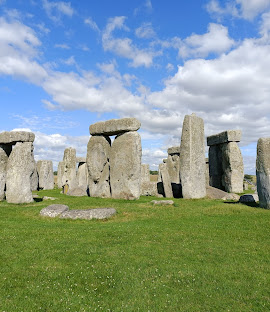
CBS Sunday Morning has a story about Stonehenge
Read more: CBS Sunday Morning has a story about StonehengeOn CBS Sunday Morning today (January 25th, 2015), there is a story about the archaeological work which is working to discover the secrets of Stonehenge. The story discusses newer techniques using underground imaging to reveal never before seen details of what Stonehendge was back when it was built. These techniques have shown the positions of missing parts of the monument and long buried locations and features in the surrounding countryside. The Smithonian Channel has a documentary that is the basis of this report. And they’re being looked at in a way that’s never been possible before, using high definition, ground-penetrating…
-

MAPS EXPO 2015 to be held April 10th – 12th, 2015
Read more: MAPS EXPO 2015 to be held April 10th – 12th, 2015MAPS EXPO 2015 will be held April 10th – 12th, 2015 at Sharpless Auctions, in Iowa City, IA. The topic is the Centozoic Era. There will be a fossil dealers, a silent auction, and much, much more. For more information, see the December MAPS newsletter. The MAPS EXPO show is the world’s largest fossil only show. The Digest Editors are calling for papers to be included in the EXPO Edition of the Digest. The theme for EXPO XXXVII is the Cenozoic Era. Papers dealing with Cenozoic fossils, localities, orstratigraphy would be appreciated. The papers should be in Word, Times New…
-
The Lizzadro Museum has “Dinosaurs at the Museum” on Saturday, January 24th
Read more: The Lizzadro Museum has “Dinosaurs at the Museum” on Saturday, January 24thRob Sula will be speaking at the Lizzadro Museum this Saturday, January 24th, 2015. His talk is titled "Form Follows Function: Interpreting Dinosaurs Through Their Anatomy". With many years of field experience, Rob is a very interesting speaker! Dinosaurs have captured our collective imagination since Sir Richard Owen first described them in 1842. Their great size alone makes them unique in the history of terrestrial vertebrates. But their bones raise many questions. What did they look like? Were they fast or slow? How did they feed? How did they defend themselves? Using actual fossils, field paleontologist, Rob Sula will interpret…
-
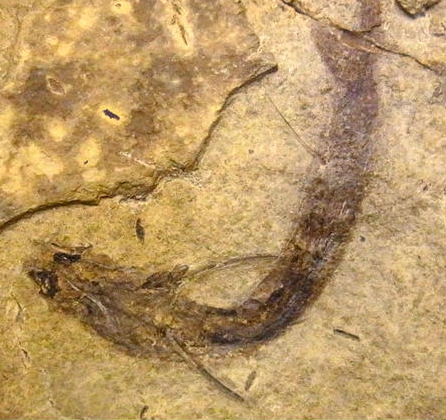
Rods and Cones Preserved in 300 Million Year Old Fish Eye
Read more: Rods and Cones Preserved in 300 Million Year Old Fish EyeFossilized rods and cones have been found in a 300 million year old fish, according to a paper published in the December 23rd, 2014 issue of Nature Communications. The photoreceptors were discovered using a scanning electron microscope. The fish, Acanthodes bridgei was found in the Hamilton Quarry in Kansas, which was a shallow lagoon in the Pennsylvannian. Because there were both rods and cones suggests that fish have been seeing in color for 300 million years. Gengo Tanaka of Kumamoto University in Japan, the lead author, said fossils from this quarry are very well preserved because they were buried very…
-
Quirks and Quarks: When Life Crawled Out of the Sea
Read more: Quirks and Quarks: When Life Crawled Out of the SeaThis week’s CBC Quirks & Quarks has a story about some of the oldest aquatic scorpions. They are about 430 to 433 million years old and from the Bruce Peninsula in Ontario. From the structure of their feet, scientists believe they may have emerged from the water to moult, probably to avoid predators at a very vulnerable time. During the Silurian, there was very little life on land and what was there was very simple. The first specimens of the new scorpion species Eramoscorpius brucensis were discovered in landscaping stone in people’s backyards and patios. The rocks were quarried in…
-
Avian Genomics Project
Read more: Avian Genomics ProjectBirds are the only surviving dinosaurs on our planet. By 2010, only three bird species (chicken, turkey, and zebra finch) had had their genome sequenced. The Avian Genomics Project selected 45 additional species for sequencing. These new species represent all 32 neognath and two of the five palaeognath orders. This allowed for a large-scale phylogenomics analysis to investigate the bird family tree, and applied comparative genomics methods to address various questions such as avian genome evolution, sex chromosome evolution, molecular basis of flight, loss of teeth, vocal learning, and endangered birds. In addition, while consuming this large body of data, new…
-
Open Access Dinosaurs
Read more: Open Access DinosaursAndy Farke has a nice article about open access science at opensouce.com. His article lists the 36 (nearly 1 a week!) new dinosaurs described in 2014. Of these 36, 17 were published in open access or free-to-read journals. That’s not much change from 2013’s 38 new and 16 free to read. It is, however, a better percentage. We’ll leave it to the reader to check for statistical significance. PLOS ONE continues to dominate the world of open access dinosaur species—nine of those 17 were published there. I will be very interested to see if this trend continues into future years, particularly…
-
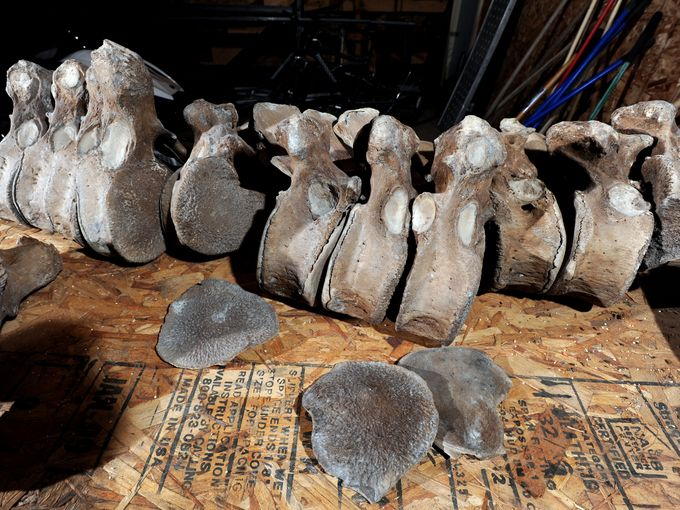
Mastodon Bones Found in Michigan Backyard
Read more: Mastodon Bones Found in Michigan BackyardWhen we say we enjoy finding fossils in our own backyard, we are usually speaking metaphorically. Eric Witcke means it literally. He and neighbor Daniel LaPoint were excavating a backyard pond at his home in Bellevue Township, Michigan, when they unearthed a paleontological treasure. They called in the some experts from the University of Michigan’s Museum of Paleontology and were told the 42 odd bones belonged to a 37 year old male Mastodon. The Mastodon lived between 10,000 and 14,000 year ago. Daniel Fisher, the director of the U of M museum, has made two trips to confirm and examine…
-

It’s Not Nessie, But Jurassic Predator Found In Scotland
Read more: It’s Not Nessie, But Jurassic Predator Found In ScotlandA new Ichthyosaur has been described in the Scottish Journal of Geology. Described as looking like a “sinister dolphin”, it was 14 foot long and lived about 170 million years ago. It’s name is Dearcmbara shawcrossi, which is pronounced ‘jark vara’. The name means “marine lizard” in Scottish Gaelic. The species name is for the discoverer Brian Shawcross. It’s bones were discovered in the late 1950s on Scotland’s Isle of Skye. “During the time of dinosaurs, the waters of Scotland were prowled by big reptiles the size of motor boats,” Dr Steve Brusatte, of the University of Edinburgh’s School of…
-
(broken link) Utah’s Dinosaur ‘Death Trap’ Reveals Trove of Giant Predators
Read more: (broken link) Utah’s Dinosaur ‘Death Trap’ Reveals Trove of Giant PredatorsNational Geographic has a story about the discovery of a Jurassic aged predator trap that is finally heading into the lab for study. The remains, probably a bed of quicksand, were discovered about 10 years ago in Utah. After years of work, a group of paleontologists have finally gotten the huge block of stone and bones down off the mesa where it was discovered. There’s an interesting video that shows how they got the chunk of sandstone onto the truck. The fossils include a prey animal skeleton, an Iguanadon, along with up to 10 specimens of Utahraptor. The preservation is…
-
Enormous Underwater Fossil Lemur Graveyard Found
Read more: Enormous Underwater Fossil Lemur Graveyard FoundHere’s a story about an enormous underwater fossil lemur graveyard. There’s a video that shows the remains of 1000 year old skeletons. Anthropologists and paleontologists uncovered what could be the largest single collection of lemur remains ever found. The remains were hidden in a series of underwater caves in a remote desert region of Madagascar. Described as a “lemur graveyard,” the discovery of hundreds of potentially 1,000-year-old skeletons make it one of the most unique animal gravesites in the world. This discovery could be important for understanding animal and human ancestry, and result in a new era for underwater paleontology.
-

The FM’s Emily Grasle Meets a Pregnant Bat and the World’s Largest Spider
Read more: The FM’s Emily Grasle Meets a Pregnant Bat and the World’s Largest SpiderIf you haven’t seen “The Brain Scoop” on youtube, head on over here and and check it out. In the latest show, she’s searching for bats and finds a huge spider in the Amazon. Emily is the Chief Curiosity Correspondent of the Field Museum in Chicago. Always an interesting show. They post new show pretty regularly about the Field Museum and research that they perform.
-
18th Annual Coal Education Conference to be held June 16-19, 2015
Read more: 18th Annual Coal Education Conference to be held June 16-19, 2015The annual Illinois Coal Education Conference will be held from June 16-19, 2015. The location will be the Rend Lake Resort and Conference Center in Wayne Fitzgerrell State Park. Participants can earn 2 graduate credit hours through Illinois State University, in Normal, IL. The deadline for registration is April 13, 2015. Each year educators from across the state attend the Annual Coal Education Conference at the Rend Lake Resort in Whittington, Illinois. The goal of the conference is to give teachers the knowledge and learning tools to incorporate first-hand information concerning coal mining to electric power generation, as well as…
-
Fracking in Ohio confirmed as cause of rare earthquake strong enough to be felt
Read more: Fracking in Ohio confirmed as cause of rare earthquake strong enough to be feltA new study links the March 2014 earthquakes in Poland Township, OH to hydraulic fracturing. The fracking activated a previously unknown fault. The quake had a magnitude of 3.0. The study was published online by the Bulletin of the Seismological Society of America (BSSA). In March 2014, a series of five recorded earthquakes, ranging from magnitude 2.1 to 3.0, occurred within one kilometer (0.6 miles) of a group of oil and gas wells operated by Hilcorp Energy, which was conducting active hydraulic fracturing operations at the time. Due to the proximity of a magnitude 3.0 event near a well, the Ohio…
-
The Burpee Museum’s New Exhibit to Open January 17th, 2015
Read more: The Burpee Museum’s New Exhibit to Open January 17th, 2015There’s a new exhibit opening at the Burpee Museum on January 17th 2015. It’s called Savage Ancient Seas. Looks good with interesting specimens. Take the plunge into the deep, dark, Savage Ancient Seas! It is the world of the late Cretaceous period-over 70 million years ago! Filled with huge carnivorous marine reptiles with double-hinged jaws and teeth in the middle of their palates, gigantic flesh-eating fish big enough to swallow an adult human being whole, flying reptiles with 3-foot skulls, and the biggest sea turtles to have ever lived! Quick tip, it’s open during Paleofest 2015.
-
Paleofest 2015
Read more: Paleofest 2015Paleofest 2015 is March 14th and 15th this year. All the details are on their website. The speaker list is long and distinguished. Don’t miss it!
-
Dino 101: Dinosaur Paleobiology
Read more: Dino 101: Dinosaur PaleobiologyClass is in session over at Coursera, they have a dinosaur class starting this week. It’s Dino 101. A good introduction to dinosaurs, how they lived, and the world they lived in. Your friendly blogger took the class a few years ago. It’s a good class with interesting content. Professor Phil Currie is one of the instructors. You may have heard him speak at a previous Paleofest in Rockford, IL.
-
Oldest horned dinosaur species in North America found in Montana: Hooked beak, sharply pointed cheeks distinguishes neoceratopsian species
Read more: Oldest horned dinosaur species in North America found in Montana: Hooked beak, sharply pointed cheeks distinguishes neoceratopsian speciesInteresting story over at ScienceDaily. The oldest known horned dinosaur has been found in Montana. The limited fossil record for neoceratopsian–or horned dinosaurs–from the Early Cretaceous in North America restricts scientists’ ability to reconstruct the early evolution of this group. The authors of this study have discovered a dinosaur skull in Montana that represents the first horned dinosaur from the North American Early Cretaceous that they can identify to the species level. The authors named the dinosaur Aquilops americanus, which exhibits definitive neoceratopsian features and is closely related to similar species in Asia. The skull is comparatively small, measuring 84 mm…

ESCONI Gem, Mineral, and Fossil Show
Most Recent Post
- ESCONI May 2026 Paleontology Study Group Meeting Saturday, May 16th, 2026 at 7:30 PM via Zoom – “An Ordovician Konzentrat Lagerstätte: The Dixon Mifflin Residuum Fauna”
 John will begin the program by introducing what a Konzentrat-Lagerstätten consists of and a brief introduction of the Platteville Formation. The depositional environment of the Mohawkian Sea, home of the Platteville fauna sets the stage for the faunal comparison.
- About ESCONI
- Around the Web
- Calendar of Events
- Code of Ethics and Conduct
- ESCONI Books for Sale
- ESCONI Gem, Mineral, and Fossil Show
- ESCONI in the News
- ESCONI Videos
- Field Trips
- Flashback Friday
- Fossil Friday
- Mazon Creek
- Mazon Monday
- Member Spotlight
- Membership Information
- Reference Material
- Throwback Thursday
- Trilobite Tuesday
Field trips require membership, but visitors are welcome at all meetings!
| Friday, May 2nd | Field Trip to Danville, IL. Details here. |
| Friday, May 8th | General Meeting – 8:00 PM via Zoom. Thomas Loebel will present “Seeing Beneath the Ground: Geophysics and Archaeological Explorations in Illinois”. |
| Saturday, May 9th | Junior Study Group Meeting – 2:00 PM, in person at the College of DuPage Technical Education Center (TEC) Building – Room 1038A (Map). “The Rock Cycle and Sedimentation” Specifics of this meeting are available from Scott Galloway, 630-670-2591, gallowayscottf@gmail.com. |
| Saturday, May 16th | Paleontology Study Group – 7:30 PM via Zoom. John Catalani will present “An Ordovician Konzentrat Lagerstätte: The Dixon Mifflin Residuum Fauna”. |
| Saturday, May 23rd | CGMA Show, Kane County Fairgrounds |
| Sunday, May 24th | CGMA Show, Kane County Fairgrounds |
| Saturday, May 30th | Field Trip to Braceville, IL. Details here. |
| Sunday, May 31st | Field Trip to Braceville, IL. Details here. |
| No meeting this month | Mineralogy Study Group |