-
Virtual: Dinosaurs of the West, with J.P. Cavigelli, Paleontologist, Thursday, July 15th, 2021
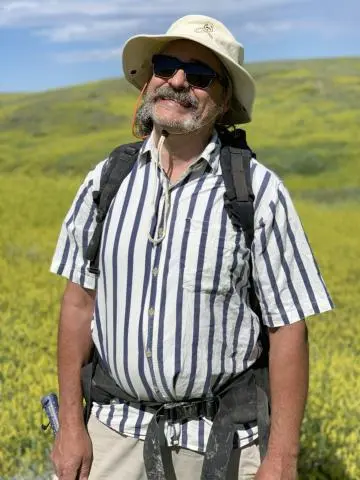
Read more: Virtual: Dinosaurs of the West, with J.P. Cavigelli, Paleontologist, Thursday, July 15th, 2021The Woodridge Public Library is have a lecture via Zoom on Thursday, July 15th, 2021. The topic is “Dinosaurs of the West” with J.P. Cavigelli, Paleontologist. Here is the annoucement… sounds very interesting! Register on their website at https://www.woodridgelibrary.org/virtual-dinosaurs-west-jp-cavigelli-paleontologist. Virtual: Dinosaurs of the West, with J.P. Cavigelli, Paleontologist Are you fascinated by the dinosaurs of the American West? Who isn’t! Have you wondered why there aren’t dinosaur fossils in Illinois? We’re very excited to welcome real-life “dinosaur fossil hunter” and paleontologist Jean-Pierre Cavigelli to discuss his excavations, discoveries, and theories of the history of dinosaurs in America. Jean-Pierre Cavigelli (JP)…
-

Report: ESCONI Field Trip to Danville Shale Pile Fossils – Saturday, June 5th, 2021
Read more: Report: ESCONI Field Trip to Danville Shale Pile Fossils – Saturday, June 5th, 2021Here is a report about the Danville Shale Pile field trip on Saturday, June 5th, 2021. Danville, Illinois, ESCONI Field Trip – June 5, 2021 The weather was warm and partly cloudy Saturday, June 5th, at the new Danville spoil pile. By midday, the temperature would reach into the 90s. Keith Robitschek started the event with his safety talk. “You’re not in Kansas anymore. You are on Pandora” … “There’s nothing like an old school safety brief to put the mind at ease.” Following the safety talk, Andrew Young discussed the geology and scientific significance of the location we were…
-

Mazon Monday #65: Palaeocaris typus
Read more: Mazon Monday #65: Palaeocaris typusThis is Mazon Monday post #65. What’s your favorite Mazon Creek fossil? Tell us at email:esconi.info@gmail.com. Another shrimp is up for this week’s Mazon Monday. We have Palaeocaris typus. P. typus was described way back in 1865 by Meek and Worthen. Fielding Bradford Meek (1817 – 1876) was an American geologist and paleontologist, who specialized in invertebrates. He had many contributions to science, including Paleaontology of California. You can find his papers at the Smithsonian Institution Archives. Amos Henry Worthen (1813 – 1888) was an American paleontologist from Illinois. He was the first curator of the Illinois State Museum.…
-
Phys.org: When tyrannosaurs dominated, medium-sized predators disappeared
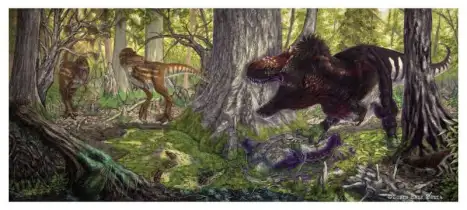
Read more: Phys.org: When tyrannosaurs dominated, medium-sized predators disappearedPhys.org has a story about tyrannosaurs… seems they didn’t share much. A new study published in the Canadian Journal of Earth Sciences found that tyrannosaur juveniles out competed medium sized carnivores wherever their adults rose to dominance. The research conducted by Thomas Holtz, a principal lecturer in the University of Maryland’s Department of Geology, verified previous anecdotal reports of a dramatic drop-off in diversity of medium-sized predator species in communities dominated by tyrannosaurs. Diversity of prey species, on the other hand, did not decline. This suggests that medium-sized predators did not disappear because of a drop off in their prey, and that something…
-
A Mysterious Crater’s Age May Add Clues to the Dinosaur Extinction
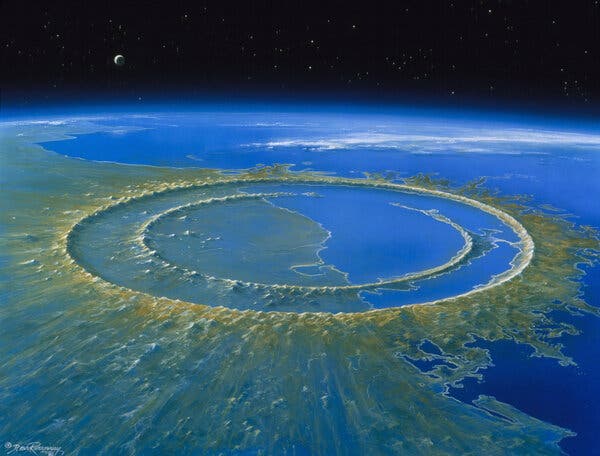
Read more: A Mysterious Crater’s Age May Add Clues to the Dinosaur ExtinctionThe New York Times Trilobites column has a story about a mysterious crater in Ukraine. Scientists have long questioned when the 15 mile wide Boltysh crater was formed, either before or after the Chicxulub crater in the Yucatan Peninsula, which caused the extinction of the non-avian dinosaurs at the end of the Cretaceous Period. A new paper in Science Advances details a study that dated rock samples from Montana and Bloltysh. This was the first study that compared Boltysh directly with the K-Pg boundary. It found that Boltysh formed about 650,000 years after the event. This result contradicts previous research…
-
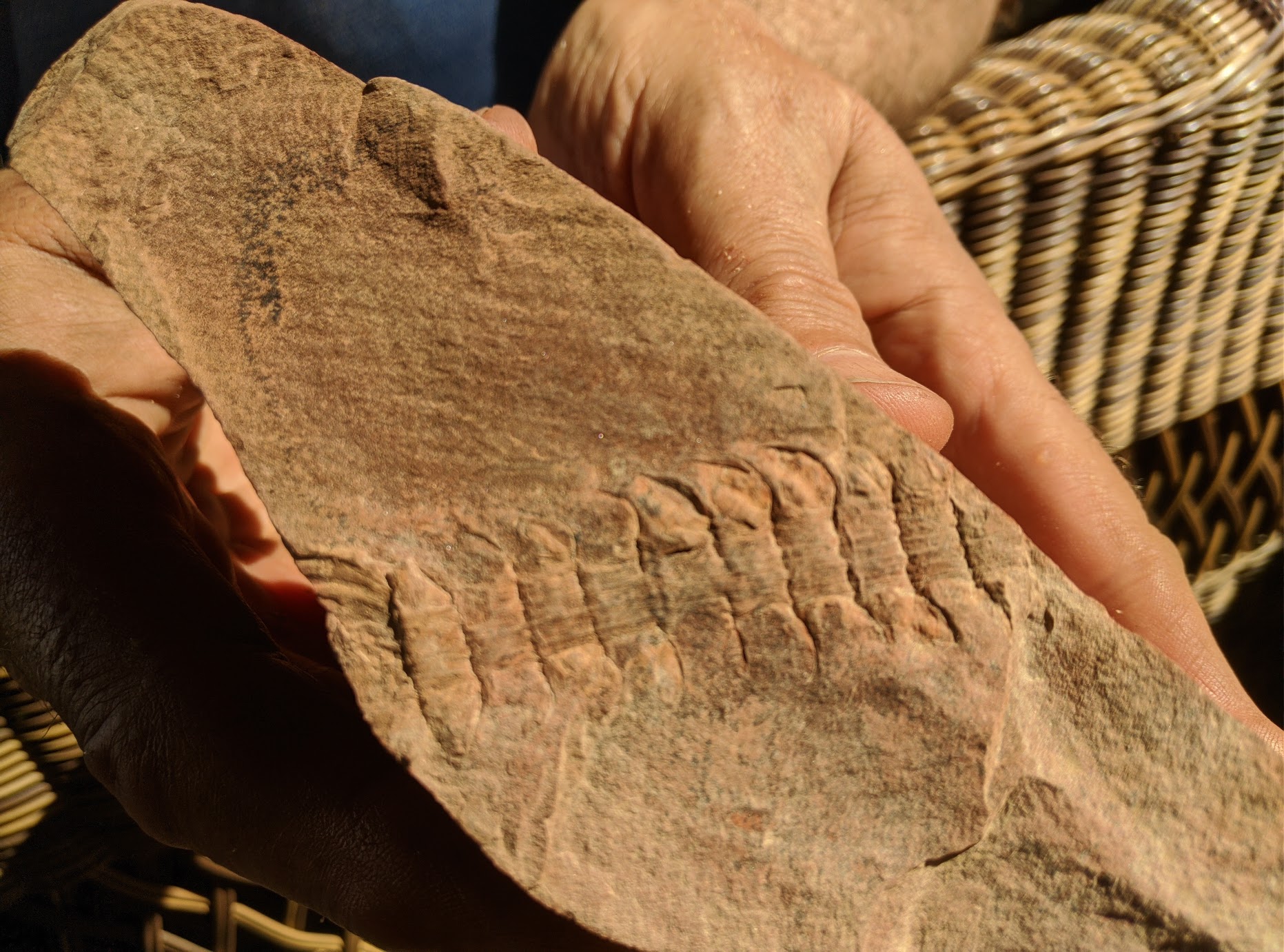
Fossil Friday #61: Calamostachys sp. from the Danville Spoil Pile
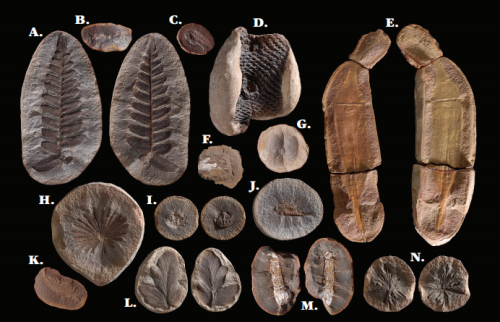
Read more: Fossil Friday #61: Calamostachys sp. from the Danville Spoil PileThis is the “Fossil Friday” post #61. Expect this to be a somewhat regular feature of the website. We will post any fossil pictures you send in to esconi.info@gmail.com. Please include a short description or story. Check the #FossilFriday Twitter hash tag for contributions from around the world! The field trip to the Danville area to collect fossils from a coal mine spoil pile was very productive. There was quite a bit of variety available, most of it plant material. Joe Vitosky joined us for his first ESCONI field trip. And, wouldn’t you know it…. he had the find of…
-
ESCONI Field Trip to Rockford-area Gravel Pit, Saturday, July 17th, 2021
Read more: ESCONI Field Trip to Rockford-area Gravel Pit, Saturday, July 17th, 2021There will be a field trip to a gravel pit in the Rockford area on July 17th, 2021. This is the same location that has been visited before. Because this is a shared trip with the Rockford club (RRVGMS) there is space for 15 ESCONI members. The trip will be from 9 AM to 12 noon. I will send the address to everyone signed up during the week prior to the trip. Note: this is a sand and gravel quarry, not the usual hard rock quarry in Rockford. There are fossils, but they come from the glacial till. So, if…
-
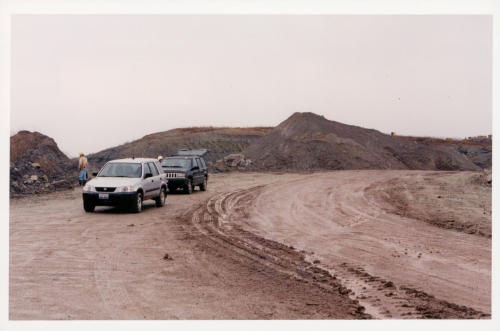
Throwback Thursday #63: Field Trip to Lone Star Quarry on April 7th, 2002
Read more: Throwback Thursday #63: Field Trip to Lone Star Quarry on April 7th, 2002This is Throwback Thursday #63. In these, we look back into the past at ESCONI specifically and Earth Science in general. If you have any contributions, (science, pictures, stories, etc …), please send them to esconi.info@gmail.com. Thanks! In April 2002, ESCONI had a field trip to Lone Star Quarry near Oglesby, IL. It looks like a rainy, muddy day. That trip was part of a yearly series to Lone Star. In some years, ESCONI had both spring and fall trips. Unfortunately, the trips ended in the late 2000’s after an unrelated boating accident on the Illinois River. Not long after…
-
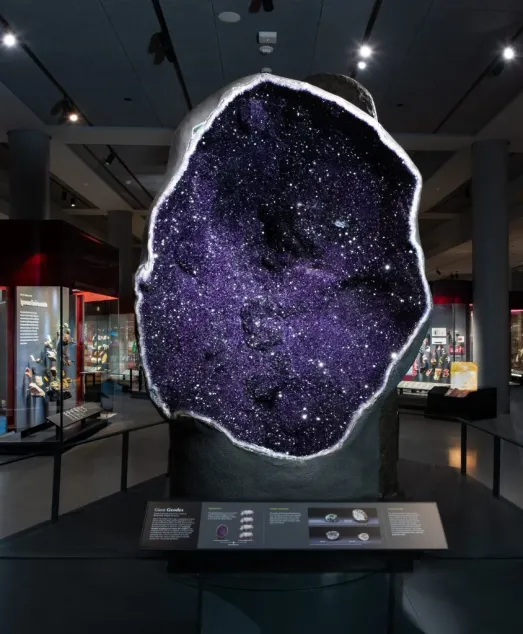
See Inside the American Museum of Natural History’s New Hall of Gems
Read more: See Inside the American Museum of Natural History’s New Hall of GemsArtnet has a story about a the AMNH’s new Hall of Gems. The new hall has been dedicated to “Nature’s Art”. The Artnet article is interesting with both pictures and descriptions. If you’re in NY, don’t miss this new exhibit. Four years ago, the Halls of Gems and Minerals at New York’s American Museum of Natural History closed for long-overdue renovations. The cavelike space, deliberately designed to evoke the feeling of the mines where many of the specimens on display had been excavated, had been essentially untouched since 1976. This week, it reopens to the public and features some 5,500 objects, from polished diamonds to rough-hewn sandstone.…
-

Mazon Monday #64: Essoidea epiceron
Read more: Mazon Monday #64: Essoidea epiceronThis is Mazon Monday post #64. What’s your favorite Mazon Creek fossil? Tell us at email:esconi.info@gmail.com. For Mazon Monday this week, we have a small filter feeding shrimp, which is one of the smallest known from the Mazon Creek fossil biota, Essoidea epiceron, was described in 1974 by Dr. Frederick Schram, who has described many fossil crustaceans including Kallidecthes richardsoni. This little guy appeared in “ESCONI Keys to Mazon Creek Animals” from 1989, “Richardson’s Guide to the Fossil Fauna of Mazon Creek”, and “The Mazon Creek Fossil Fauna”. Excerpts are shown below. From “ESCONI Keys to Mazon Creek Animals”… with…
-

Cretaceous Dinosaurs Lived in Warm and Variable Greenhouse Climate, Study
Read more: Cretaceous Dinosaurs Lived in Warm and Variable Greenhouse Climate, StudySciNews has a piece about the climate during the end of the Cretaceous Period. Researchers looked at various data, including oyster and rudist shells, to reconstruct a picture of the paleo climate during the Campanian (late Cretaceous Period) about 78 million years ago in what is now modern day Sweden. They found that the climate was much more variable than previously thought, with winters fluctuating between about 15 degrees Celsius (59 degrees Fahrenheit) in the winter to 27 degrees Celsius (80 degrees Fahrenheit) in the summer. Find all the details in a paper which was published in the journal Communications…
-
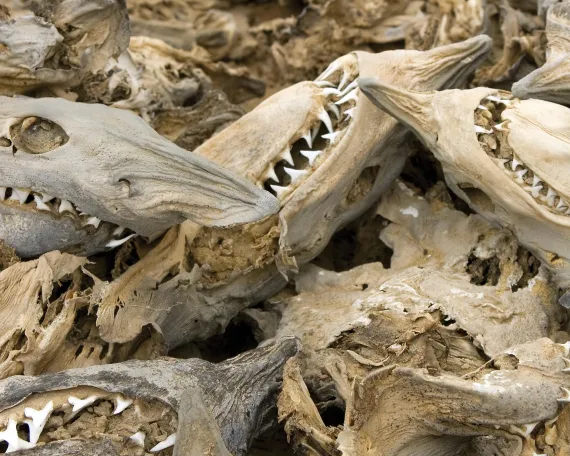
Puzzling Extinction Event Decimated Sharks 19 Million Years Ago
Read more: Puzzling Extinction Event Decimated Sharks 19 Million Years AgoSciTechDaily has an article about a shark extinction, which took place about 19 million years ago during the early Miocene. A new study published in the journal Science looked at shark diversity over the last 40 million years and found an extinction event that reduced shark diversity by about 90%. In a related Perspective article in Science, the authors add more details. Nineteen million years ago, sharks nearly disappeared from Earth’s oceans, according to a new study, which provides evidence for a previously unknown mass ocean extinction event. Sharks as a species never recovered from this, the study’s authors…
-

Fossil Friday #60: Calymene celebra
Read more: Fossil Friday #60: Calymene celebraThis is the “Fossil Friday” post #60. Expect this to be a somewhat regular feature of the website. We will post any fossil pictures you send in to esconi.info@gmail.com. Please include a short description or story. Check the #FossilFriday Twitter hash tag for contributions from around the world! This week, we have a trilobite for Fossil Friday. Calymene celebra is a common trilobite found in Illinois, Indiana, and Wisconsin. It lived during the Silurian Period, which lasted from about 443 to 419 million years ago. This species belongs to the order Phacopida. This specimen is preserved in Niagara dolamite and…
-
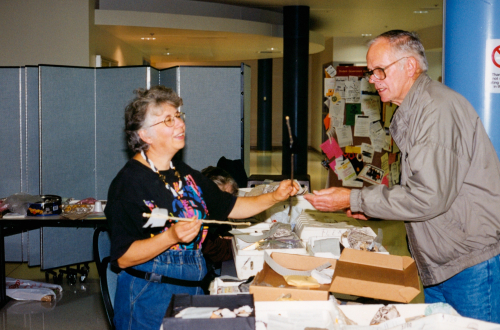
Throwback Thursday #62: ESCONI Flea Market 10-02-1999
Read more: Throwback Thursday #62: ESCONI Flea Market 10-02-1999This is Throwback Thursday #62. In these, we look back into the past at ESCONI specifically and Earth Science in general. If you have any contributions, (science, pictures, stories, etc …), please send them to esconi.info@gmail.com. Thanks! For a long time, ESCONI has held the Gem, Mineral, and Fossil Show each spring in March. Quite often, a Flea Market was held in October. That practice stopped about 10 years ago, but we will be holding a similar event on October 9th, 2021. It’s our slimmed down 2021 show… the Pandemic Edition. Here are some pictures from the October 2nd, 1999…
-
ESCONI June 2021 General Meeting – June 11th, 2021 at 8:00 PM via Zoom – “The Glasford Structure: A Marine Target Impact Crater with a Possible Connection to the Great Ordovician Meteorite Shower”
Read more: ESCONI June 2021 General Meeting – June 11th, 2021 at 8:00 PM via Zoom – “The Glasford Structure: A Marine Target Impact Crater with a Possible Connection to the Great Ordovician Meteorite Shower”The speaker at our June 2021 meeting will be Charles Monson from ISGS. Charles recently published on the Glasford Illinois impact structure and its relation to the Ordovician meteor event. WCBU, a joint service of Bradley University and Illinois State University, interviewed Charles back in November 2019. Their program is online and available for listening. His paper was published in the journal Meteoritics and Planetary Science. Glasford Meteor May Have Played A Role in Ancient Ice Age New research on a central Illinois crater suggests possible links to an Ice Age about 455 million years ago. Charles Monson is an…
-
ESCONI July 2021 Junior Field Trip – Dave’s Down to Earth Rock Shop July 12th, 2021 10 AM
Read more: ESCONI July 2021 Junior Field Trip – Dave’s Down to Earth Rock Shop July 12th, 2021 10 AMHello juniors families, I am planning a field trip, for juniors families only, on July 12th. To start the morning out we will meet at a Home Depot in Evanston, IL at 10:00. There we will have a scavenger hunt to determine what items, for sale in the store, are made of rocks and minerals that are obtained from nature. Here your child can earn check marks for an earth resources achievement badge. Then we will walk from the parking lot of Home Depot to Northshore Sculpture Park which is a 17 minute walk. After viewing sculptures and possibly picking…
-

NYT: New Dinosaur Species Is Australia’s Largest, Researchers Say
Read more: NYT: New Dinosaur Species Is Australia’s Largest, Researchers SayThe New York Times has a story about a new dinosaur… from Australia. Australotitan cooperensis is a titanosaur, which is a type of sauropod. It weighted about 70 tons and lived about 90 million years ago during the Cretaceous Period. It’s the largest dinosaur known from Australia. The dinosaur was described in a paper in the journal PeerJ. Robyn and Stuart Mackenzie, riding motorbikes one day in 2006 on their vast sheep and cattle farm in the Australian outback, spotted a pile of what looked like large black rocks. On close inspection, they appeared to be dinosaur bones. An even…
-
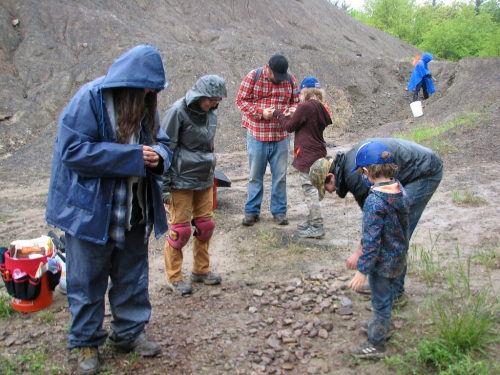
Mazon Monday #63: Braceville Field Trip Report
Read more: Mazon Monday #63: Braceville Field Trip ReportThis is Mazon Monday post #63. What’s your favorite Mazon Creek fossil? Tell us at email:esconi.info@gmail.com. This spring’s field trip to the Braceville spoil pile started as a cool, cloudy day with a chance of rain. 45 members chanced the weather to collect Mazon Creek fossil concretions. Around 10:30, a steady, but light, drizzle fell and continued on and off until after lunch. This drizzle and rain from a few days before washed away dirt and clay which exposed many concretions, which made surface collecting a little easier. The rain didn’t stop a Scarlet Tanager from visiting participants during lunch.…
-
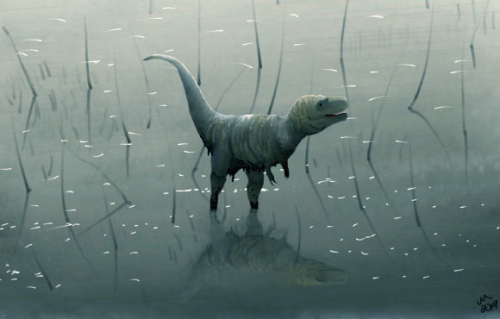
Juvenile Tyrannosaurs Had Powerful Bite, New Study Shows
Read more: Juvenile Tyrannosaurs Had Powerful Bite, New Study ShowsSciNews has a story about Tyrannosaurus rex. A recent study looked the bite force of juvenile T. rex and found they had a bite force somewhere between modern hyenas and crocodiles at about 5,641 newtons. Humans deliver a force less than 1/10 at around 300 newtons. Details of the story can be found in a paper in PeerJ by researchers at the University of Wisconsin Oshkosh. For the study, University of Wisconsin Oshkosh’s Professor Joseph Peterson and colleagues made a replica of the scimitar-shaped tooth of a young Tyrannosaurus rex using a dental-grade cobalt chromium alloy. They then mounted the metal tooth…

ESCONI Gem, Mineral, and Fossil Show
Most Recent Post
- Early Triassic Cyclidan Crustacean Had Powerful Jaws
 Sci-News has an article about a distinctive, but enigmatic, group of arthropods called Cyclidans. Cyclidans appeared during the Carboniferous and hung around until the Late Cretaceous.
- About ESCONI
- Around the Web
- Calendar of Events
- Code of Ethics and Conduct
- ESCONI Books for Sale
- ESCONI Gem, Mineral, and Fossil Show
- ESCONI in the News
- ESCONI Videos
- Field Trips
- Flashback Friday
- Fossil Friday
- Mazon Creek
- Mazon Monday
- Member Spotlight
- Membership Information
- Reference Material
- Throwback Thursday
- Trilobite Tuesday
Field trips require membership, but visitors are welcome at all meetings!
| Friday, April 10th | General Meeting – 8:00 PM via Zoom. Jessica Hull will present “Life in the Devonian Period, The Age of Fishes.” |
| Saturday, April 11th | Junior Study Group Meeting – 2:00 PM, in person at the College of DuPage Technical Education Center (TEC) Building – Room 1038A (Map). Katherine Howard will present on Sand and Sediment Collecting. Specifics of this meeting are available from Scott Galloway, 630-670-2591, gallowayscottf@gmail.com. |
| Saturday, April 18th | Paleontology Study Group – 7:30 PM via Zoom and in person at the College of DuPage, TEC, Room 1038B (Map). Keith Robitschek will present “Digging the Marl of the Lance Formation.” |
| Friday, April 24th | MAPS Expo XLVII – Springfield, IL. |
| Saturday, April 25th | MAPS Expo XLVII – Springfield, IL. |
| Sunday, April 26th | MAPS Expo XLVII – Springfield, IL. |
| No meeting this month | Mineralogy Study Group |