
-
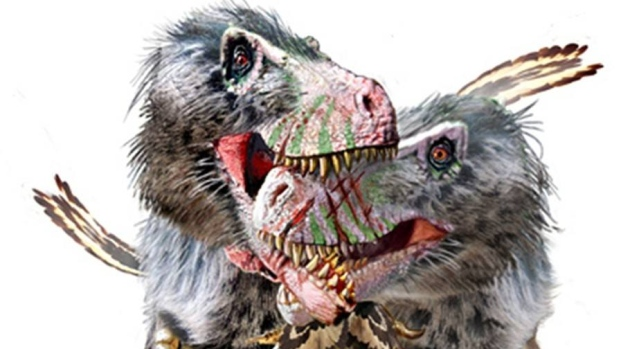
CBC Quirks & Quarks – Dinosaur Cannibals
Read more: CBC Quirks & Quarks – Dinosaur CannibalsCBC’s Quirks & Quarks has an interview with Dr. David Hone. He’s a paleontologist and lecturer in Zoology at Queen Mary, University of London. He’s been studying scarring on a Daspletosaurus skull, which was found in Alberta’s Dinosaur Provincial Park. He and his colleague, Darren Tanke, have concluded that the wounds were caused by other Daspletosaurs. The original paper appeared in the journal PeerJ. Dr. Hone has a post that details the findings on his blog, Archosaur Musings.
-

Reminder: Field Trip: Braceville, IL, Mazon Creek Fossils May 16-17, 2015
Read more: Reminder: Field Trip: Braceville, IL, Mazon Creek Fossils May 16-17, 2015Collecting Mazon Creek Fossils on private property Meet at 8:00 AM Saturday or Sunday at the BP Amoco in Coal City. No Age Limit. Hard Hats not required. Take I-55 to Exit 236 (Coal City). Take a right onto Highway 113 (Division Street). Go west to Broadway Street and Division in Coal City. We will be collecting Mazon Creek concretions from an old spoil pile on private property. Hard hats are not required. Boots are recommended. An Estwing rock hammer is the best tool. A small shovel or pick is helpful. Knee pads, backpacks, fanny packs, extra clothes (you will…
-
(broken link) Chicken Grows Face of a Dinosaur
Read more: (broken link) Chicken Grows Face of a DinosaurThe BBC’s Earth Blog has a story that describes a chicken embryo that developed a dinosaur-like snout instead of a beak. The research was performed by a team of scientists that included Bhart-Anjan Bhullar of Yale University and Arhat Abzhanov of Harvard University. The original paper appeared in the journal Evolution. To understand how one changed into another, a team has been tampering with the molecular processes that make up a beak in chickens. By doing so, they have managed to create a chicken embryo with a dinosaur-like snout and palate, similar to that of small feathered dinosaurs like Velociraptor.…
-
The Godley Mining Museum Needs Your Help
Read more: The Godley Mining Museum Needs Your HelpOn Sunday May 31st, 10 am., volunteers will be meeting at the Godley Mining Museum in Godley, IL to help identify Mazon Creek specimens and help to clean up and improve the inside of the museum. This is a small one room museum located on Illinois Route 66. If you want to help the Godley Museum or have further questions about the day, feel free to contact Joe Kubal, who is the ESCONI contact at 630-983-6159 or jdrk4715@aol.com.
-
Pictures From Rob Sula’s Presentation at the May 2015 General Meeting
Read more: Pictures From Rob Sula’s Presentation at the May 2015 General MeetingHere are some pictures from Rob Sula’s great presentation at the May 2015 General Meeting.
-
Box Left At Friday’s Meeting
Read more: Box Left At Friday’s MeetingDid anyone leave a white box with “Silent Auction 2008” written on the top? There were a few Mazon Creek fossils inside. Comment here and I’ll bring it to the next meeting.
-
Past Time – A Paleontology Podcast
Read more: Past Time – A Paleontology PodcastRecently, I found another paleontology podcast. It’s called Past Time. It’s hosted by a couple graduate students in the Department of Anatomical Sciences at Stony Brook University on Long Island, New York. It’s very good. Episodes tend to be of the news flash format, but there are longer ones with interviews. The stories are well researched with many references. The most recent one is “News Bite: Cosmic rays date ancient human ancestor”. Check it out. If you like to mix your paleontology with your podcasts, you will like this one. Enjoy!
-
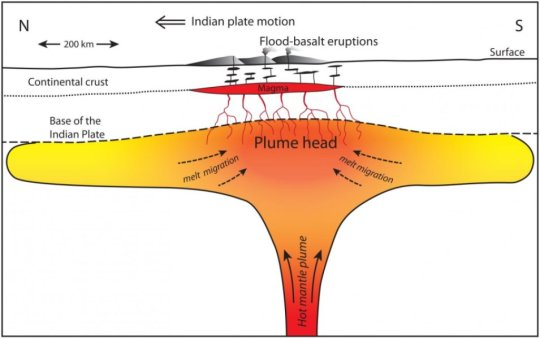
Did dinosaur-killing asteroid affect the largest lava flows on Earth?
Read more: Did dinosaur-killing asteroid affect the largest lava flows on Earth?Science Daily has an interesting article on the extinction of the dinosaurs, 65 million years ago. The K-T extinction event has been thought to be caused by a large meteor impact off the coast of the Yucatan peninsula. However, at the same time, there were massive volcanic eruptions occurring in the middle of the Indian sub-continent. This volcanic deposit is called the Deccan Traps. The deposit formed over a period of a million years, and the source is believed to be a mantle plume. That mantle plume existed and was flowing before the impact. Now, a group headed by Mark Richards at…
-
Oldest Known Ancestor of Modern Birds
Read more: Oldest Known Ancestor of Modern BirdsA recreation of Archaeornithura meemannae. – Zongda Zhang Discovery has a story of the oldest known ancestor of living birds. Archaeornithura meemannae lived in what is now northeastern China, over 130 million year ago. This pushes back the timeline for modern birds by about 6 million years. At 145 million years old, Archaeopteryx is still the oldest bird, but it has no living decendants. Original paper in the journal Nature. The newly found bird looked “nearly” like today’s shorebirds, senior author Zhonghe Zhou told Discovery News, although A. meemannae “could have been preyed upon by carnivorous dinosaurs.” Zhou is director of the Institute of Vertebrate Paleontology and Paleoanthropology…
-
Ancient megadrought entombed dodos in poisonous fecal cocktail
Read more: Ancient megadrought entombed dodos in poisonous fecal cocktailThat title says quite a bit… The story in the Science Magazine details how the dodos and giant tortoises of Mauritius almost went extinct 3800 years before the Dutch arrived to hunt them down. The original paper appeared in the journal The Holocene. Nine hundred kilometers off the east coast of Madagascar lies the tiny island paradise of Mauritius. The waters are pristine, the beaches bright white, and the average temperature hovers between 22°C and 28°C (72°F to 82°F) year-round. But conditions there may not have always been so idyllic. A new study suggests that about 4000 years ago, a prolonged…
-

Bizarre Cousin of T. Rex Was a Vegetarian
Read more: Bizarre Cousin of T. Rex Was a VegetarianLivescience has a story of a new dinosaur, Chilesaurus diegosuarezi. The name is in honor of both Chile and the discoverer, Diego Suarez. It was discovered by the 7-year-old son of two geologists in 2010. A few dinosaur vertebrae were spotted by the observant boy during an expedition with his family in Aysen, a region of southern Chile. The 9.8 foot long animal lived about 145 million years ago during the late Jurassic period. It is a rare case of a plant eating theropod. The original paper appeared in the journal Nature. Since Diego’s discovery, collaborating Chilean and Argentinian scientists…
-
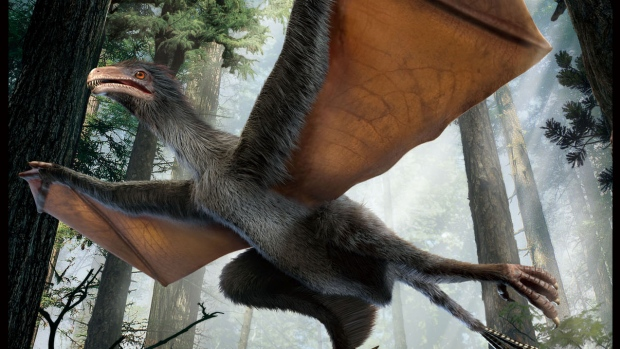
CBC Quirks & Quarks – A Bat-Winged Dinosaur
Read more: CBC Quirks & Quarks – A Bat-Winged DinosaurYi qi. Credit: Dinostar Co. Ltd The week’s episode of the CBC’s Quirks & Quarks has a segment on a very strange new dinosaur from China. The animal is named Yi qi, pronounced “ee chee”), which comes from Mandarin for “strange wing”. The fossil dates to the late Jurassic about 160 million years ago. Original paper in the journal Nature. Canadian paleontologist Dr. Corwin Sullivan calls it the strangest specimen he’s ever seen. He and a team of Chinese colleagues have determined that a small, bipedal, dinosaur fossil, dating back 160 million years, had a bat-like membrane wing, which means…
-
NOTE: Room Change for Friday’s General Meeting, BIC Room 1528
Read more: NOTE: Room Change for Friday’s General Meeting, BIC Room 1528The general meeting, which includes Rob Sula’s talk about the dinosaurs of the Hell Creek Formation, will occur in the Berg Instructional Center building in room 1528 (map).
-
The Burpee Museum: NEW EXHIBIT OPENING With Special Talk from Dr. Hans-Dieter Sues
Read more: The Burpee Museum: NEW EXHIBIT OPENING With Special Talk from Dr. Hans-Dieter SuesNEW EXHIBIT OPENING! With Special Talk from Dr. Hans-Dieter Sues* May 9, 2015 10:00 AM – 5:00 PM This unique exhibit brings us a snapshot in time of Jurassic life 150 million years ago. Directly across from the paleontology viewing lab, Snapshots in Time: The Unique Paleofauna of the Solnhofen Limestone showcases some of the worlds rarest Late Jurassic fossils discovered in the Solnhofen Limestone, of southern Germany. No other locale has produced more iconic fossils from this time period than the Solnhofen Limestone, and Rockford’s own Burpee Museum will display the most unique of the collection! *To enhance…
-
ESCONI Member Jack Wittry Wins 2015 Strimple Award
Read more: ESCONI Member Jack Wittry Wins 2015 Strimple AwardESCONI Member Jack Wittry (Field Associate, The Field Museum) has won the 2015 Strimple Award from The Paleontological Society. Jack has been an ESCONI member for many years. Among his many contributions are two important books that describe the Mazon Creek fossil flora and fauna. Congratulations Jack! The Harrel S. Strimple Award recognizes outstanding achievement in paleontology by amateurs (someone who does not make a living full-time from paleontology). Contributions may be an outstanding record of research and publication, making outstanding collections, safeguarding unique paleontological materials through public service, teaching activities in the area of paleontology, and collaborations with others working in paleontology.…
-

ESCONI Events May 2015
Read more: ESCONI Events May 2015Fri, May 8 ESCONI General Meeting 8:00 p.m. College of Dupage – Berg Instructional Center (BIC), Room 1528 (Map) – Topic: “The Hell Creek Formation: The Twilight of Non-Avian Dinosaurs.” by Rob Sula Sat, May 9 ESCONI Mineralogy Meeting 7:30 p.m. College of Dupage – Tech Ed (TEC) Building, Room 1038B (Map) – Topic: “Evaporites”, ESCONI member Jim Daly Fri, May 15 ESCONI Archaeology Study Group Meeting, Canceled Sat, May 16 ESCONI Field Trip: Braceville, Collect Mazon Creek Fossils in Braceville, IL. See here for details. Sat, May 16 ESCONI Paleontology Study Group Meeting 7:30 p.m. College of Dupage, – Tech EdBuilding (TEC), Room…
-
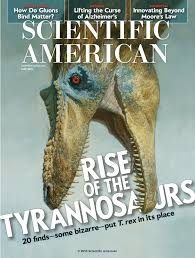
Meet the New Tyrannosaurs
Read more: Meet the New TyrannosaursScientific American has a video of Dr. Stephen Brusatte of the University of Edinburgh. In it, he charts the thrilling ascent of the tyrannosaurs. The May issue of Scientific American has a story called “Rise of the Tyrannosaurs”, which is highlighted on the cover of the magazine.
-
CBC Quirks & Quarks – Blueprint for a Woolly Mammoth
Read more: CBC Quirks & Quarks – Blueprint for a Woolly MammothThe week’s episode of CBC Quirks & Quarks has a segment on the sequencing of the full genome of the Woolly Mammoth. Dr. Hendrik Poinar, and evolutionary geneticist and Directory of the Ancient DNA Centre at McMaster University in Hamilton, Ontario, Canada, and colleagues extracted DNA from two mammoths, one is 45,000 years old and the other one is 4,000 years old. The original paper appeared in Current Biology. The giant, hairy elephants that used to roam the grasslands of the Arctic have been extinct for thousands of years, but thanks to DNA preserved in permafrost, the genome of the Woolly…
-

Palaeocast Episode 43: Ancient DNA
Read more: Palaeocast Episode 43: Ancient DNAThe new palaeocast episode is about ancient DNA. Over the last few years, more and more biologic material is being found associated with fossils. The main reason why we find it now is because we weren’t looking previously. DNA (deoxyribonucleic acid) is a molecule that encodes the genetic information within every species of life on earth. The information contained within the sequence of base pairs determines how any given organism develops and biologically functions. DNA is not just limited to the biological study, but is also now being utilised in palaeontology. But why is DNA not normally preserved? What’s the…
-
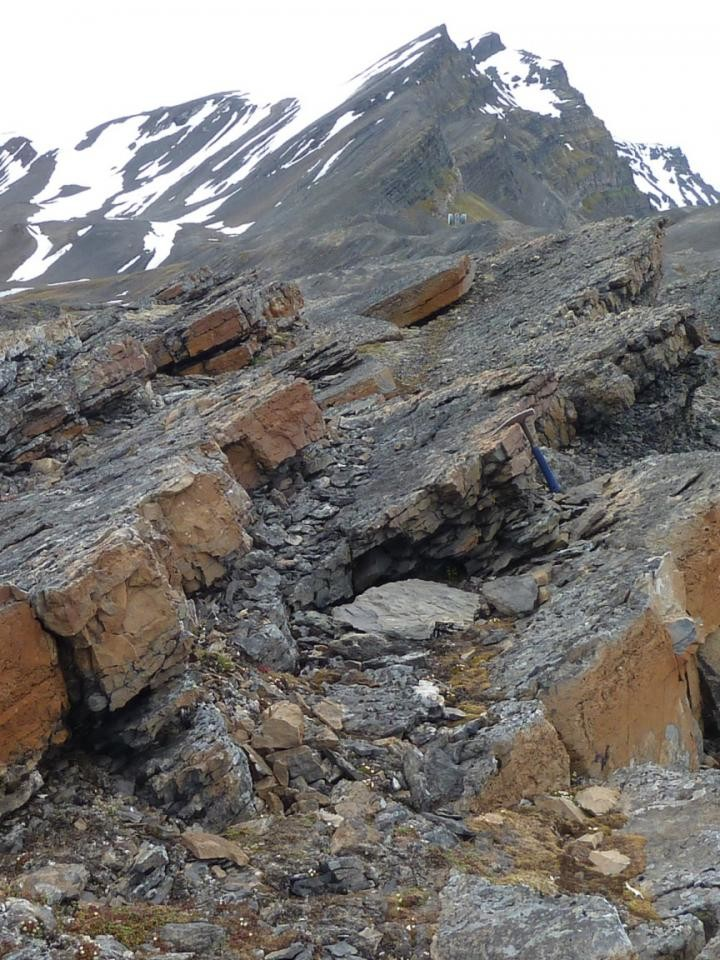
Science Daily: New evidence adds the Capitanian extinction to the list of major extinction crises
Read more: Science Daily: New evidence adds the Capitanian extinction to the list of major extinction crisesCredit: Photographer: Dierk Blomeier. For David P.G. Bond and colleagues, GSA Bulletin, 2015. Science Daily has a story about the Capitanian Extinction event. This event occurred in the mid-Permian, around 10 million years before the end Permian mass extinction, otherwise known as the “Great Dying”. At first it was thought to be a more local event, but now evidence from the high latitudes shows it to be global. The original paper appeared in the journal Geological Society of America Bulletin. Until now, this Capitanian extinction was known only from equatorial settings, and its status as a global crisis was controversial.…

ESCONI Gem, Mineral, and Fossil Show
Most Recent Post
- Trilobite Tuesday #50: Penn Dixie: Dig With the Experts 2026 – June 13th and 14th, 2026
 The Penn Dixie Fossil Park and Nature Center are holding their annual “Dig With the Experts” event on June 13th and 14th, 2026. Details can be found be found on their website. We’ve featured a few trilobites from Penn Dixie for Fossil Friday. I went there a few years ago and had a great time. If you love trilobites, don’t miss this event!
- About ESCONI
- Around the Web
- Calendar of Events
- Code of Ethics and Conduct
- ESCONI Books for Sale
- ESCONI Gem, Mineral, and Fossil Show
- ESCONI in the News
- ESCONI Videos
- Field Trips
- Flashback Friday
- Fossil Friday
- Mazon Creek
- Mazon Monday
- Member Spotlight
- Membership Information
- Reference Material
- Throwback Thursday
- Trilobite Tuesday
Field trips require membership, but visitors are welcome at all meetings!
| Friday, May 2nd | Field Trip to Danville, IL. Details here. |
| Friday, May 8th | General Meeting – 8:00 PM via Zoom. Thomas Loebel will present “Seeing Beneath the Ground: Geophysics and Archaeological Explorations in Illinois”. |
| Saturday, May 9th | Junior Study Group Meeting – 2:00 PM, in person at the College of DuPage Technical Education Center (TEC) Building – Room 1038A (Map). “The Rock Cycle and Sedimentation” Specifics of this meeting are available from Scott Galloway, 630-670-2591, gallowayscottf@gmail.com. |
| Saturday, May 16th | Paleontology Study Group – 7:30 PM via Zoom. John Catalani will present “An Ordovician Konzentrat Lagerstätte: The Dixon Mifflin Residuum Fauna”. |
| Saturday, May 23rd | CGMA Show, Kane County Fairgrounds |
| Sunday, May 24th | CGMA Show, Kane County Fairgrounds |
| Saturday, May 30th | Field Trip to Braceville, IL. Details here. |
| Sunday, May 31st | Field Trip to Braceville, IL. Details here. |
| No meeting this month | Mineralogy Study Group |