
-
Time Change: ESCONI 2017 Holiday Dinner Friday, December 1st, 2017
Read more: Time Change: ESCONI 2017 Holiday Dinner Friday, December 1st, 2017Please note the time change from 6:00 PM to 5:30-7:30 PM The ESCONI 2017 Holiday Dinner is scheduled for Friday, December 1st, 2017 at Cozymel’s in Wheaton, starting at 5:30-7:30 PM. The room has been reserved for 30 people but we can handle a few more if needed. I have asked them to set up the tables in a different configuration than the “L” shape from the last two years, since it creates a space problem for those sitting at the inside corner. The December speaker is Dr. Kerry Sagebiel from NIU. The title of her program is…
-

ESCONI Events November 2017
Read more: ESCONI Events November 2017Field trips require membership, but visitors are welcome at all meetings! Sat, Nov 4th Field Trip – Thornton Quarry – see here for details. Fri, Nov 10th ESCONI General Meeting, 8:00 PM College of Dupage – Tech Ed (TEC) Building, Room 1038B (Map) – Topic: “What do we know about life on early Earth?” by D’Arcy, Meyer-Dombard of UIC Sat, Nov 11th ESCONI Minerology Study Group Meeting, 7:30 PM College of Dupage – Tech Ed (TEC) Building, Room 1038B (Map) – Topic: “Copper Minerals” Sat, Nov 18th ESCONI Paleontology Study Group Meeting, 7:30 PM College of Dupage – Tech Ed…
-

Meet the giant dinosaur that roamed southern Africa 200 million years ago
Read more: Meet the giant dinosaur that roamed southern Africa 200 million years agoLara Sciscio, University of Cape Town Globally at around 200 million years ago, in what’s known as the Early Jurassic, small and agile two-legged carnivorous dinosaurs called theropods roamed the ancient landscapes. In southern Africa, we know of their existence from their rare body fossils but also, importantly, from their fossil footprints. Now our team’s new discovery, published in PLOS ONE, unexpectedly reveals that very large carnivorous dinosaurs with an estimated body length of between 8 to 9 meters (or 26 feet) – that’s a two-story building or two adult rhinos nose to tail – lived in southern Africa too.…
-
General Meeting November 10th, 2017: What do we know about life on early Earth?
Read more: General Meeting November 10th, 2017: What do we know about life on early Earth?The title of Dr. D’Arcy Meyer-Dombard’s program at our November 2017 meeting is “What do we know about life on early Earth?” The speaker at our February 9, 2018 meeting will be Dr. Dan Gebo from the Department of Anthropology at NIU. His research focuses on understanding locomotor adaptation and evolution in living and fossil primates, particularly the haplorhines (the clade that includes humans). You can read more about him at http://www.niu.edu/anthro/faculty_staff/faculty/gebo.shtml
-
ESCONI 2017 Holiday Dinner Friday, December 1st, 2017
Read more: ESCONI 2017 Holiday Dinner Friday, December 1st, 2017The ESCONI 2017 Holiday Dinner is scheduled for Friday, December 1st, 2017 at Cozymel’s in Wheaton, starting at 5:30-7:30 PM. The room has been reserved for 30 people but we can handle a few more if needed. I have asked them to set up the tables in a different configuration than the “L” shape from the last two years, since it creates a space problem for those sitting at the inside corner. The December speaker is Dr. Kerry Sagebiel from NIU. The title of her program is “In the Realm of the Submerged Crocodile: Archaeology at the Maya City…
-
ESCONI Field Trip: Saturday, November 4th, 2017 to Thornton Quarry
Read more: ESCONI Field Trip: Saturday, November 4th, 2017 to Thornton QuarryThere will an ESCONI field trip to the Thornton Quarry on Saturday November 4, 2017 from 8 AM to 12 noon. The weather can be challenging in November, so think nice warm thoughts, and we’ll give it a try! I don’t have all the details but here is what I have so far: 1. Everyone in your party must be an ESCONI member. 2. Everyone in your party must be at least 18 years of age. 3. Maximum of 30 people total. 4. Standard safety equipment required – hard hat (no bike helmets), boots, safety…
-

Humans Today Have Even More Neanderthal DNA Than We Realised
Read more: Humans Today Have Even More Neanderthal DNA Than We RealisedGeorge Dvorsky Oct 6, 2017, 6:00pm Before this new study, only four Neanderthal specimens have had their genomes sequenced. Of these, only one — an Altai Neanderthal found in Siberia — was of sufficient quality, where scientists were able to accurately flag variations in the genome. The new analysis, enabled by a remarkably well-preserved genome taken from a 52,000 year old bone fragment, is now the second Neanderthal genome to be fully sequenced in high fidelity. The resulting study, now published in Science, confirms a bunch of things we already knew about Neanderthals, while also revealing some things we didn’t…
-
Humans Today Have Even More Neanderthal DNA Than We Realised
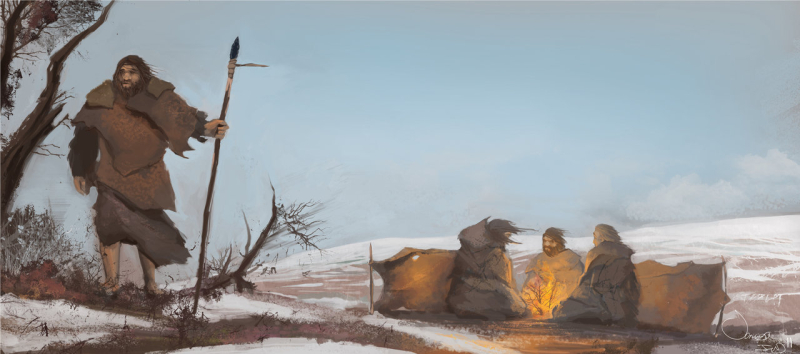
Read more: Humans Today Have Even More Neanderthal DNA Than We RealisedGeorge Dvorsky Oct 6, 2017, 6:00pm A international team of researchers has completed one of the most detailed analyses of a Neanderthal genome to date. Among the many new findings, the researchers learned that Neanderthals first mated with modern humans a surprisingly long time ago, and that humans living today have more Neanderthal DNA than we assumed. Before this new study, only four Neanderthal specimens have had their genomes sequenced. Of these, only one — an Altai Neanderthal found in Siberia — was of sufficient quality, where scientists were able to accurately flag variations in the genome. The new analysis,…
-

Earth Science Week is October 8th-14th, 2017
Read more: Earth Science Week is October 8th-14th, 2017Earth Science Week 2017 is October 8th-14th. It includes National Fossil Day on Wednesday, October 11th, 2017. Here is a link with events near you!
-
ESCONI Events October 2017
Read more: ESCONI Events October 2017Field trips require membership, but visitors are welcome at all meetings! Sun, Oct 8th Field Trip – Irene Quarry – see here for details. Fri, Oct 13th ESCONI General Meeting, 8:00 PM College of Dupage – Tech Ed (TEC) Building, Room 1038B (Map) – Topic: “Fluorite and Rare Earth Elements in the Illinois-Kentucky Fluorspar District” by Brett Denny, with the Illinois State Geological Survey Sat, Oct 14th ESCONI Minerology Study Group Meeting, 7:30 PM College of Dupage – Tech Ed (TEC) Building, Room 1038B (Map) – Topic: “Discussion of Fluorites” Wed, Oct 11th Happy National Fossil Day! – see here…
-
ESCONI Field Trip: October 8th, 2017 to Irene Quarry
Read more: ESCONI Field Trip: October 8th, 2017 to Irene QuarryThere will be a field trip to the Irene Quarry near Belvidere, Illinois on Sunday, Oct 8 2017, from 9AM to 12 Noon. The rock is Ordovician, Galena Group. This is a “hard-rock” quarry (dolomite). If you like Hormotoma or Receptaculites, this is the place for you! Rules: 1. Everyone in your group MUST be an ESCONI member. 2. Everyone in your group MUST be at least 18 years of age. 3. Everyone MUST have and wear a hard hat, safety vest, and sturdy boots while in the quarry. No sandals, tennis shoes, and the…
-
Dinner & A Little History: Coal, Shale, and Ironstone: The Geology & Paleontology of Mazon Creek
Read more: Dinner & A Little History: Coal, Shale, and Ironstone: The Geology & Paleontology of Mazon CreekOctober Dinner Lecture October Dinner Lecture October Dinner Lecture October Dinner Lecture October Dinner Lecture October Dinner Lecture 33 Years of Powerful Partnerships Exciting events, engaging lectures, and outdoor activities along the I&M Canal! Dinner & A Little History: Coal, Shale, and Ironstone: The Geology & Paleontology of Mazon Creek Join the Canal Corridor Association, Thursday October 5th 2017, at the Lock 16 Cafe & Visitor Center for our Dinner lecture series: Coal, Shale, and Ironstone: The Geology & Paleontology of Mazon Creek Located in northeastern Illinois, Mazon Creek is an incredible fossil array of associated Upper Carboniferous plants and animals. Considered…
-
October General Meeting on October 13th, 2017: Fluorite and Rare Earth Elements in the Illinois-Kentucky Fluorspar District
Read more: October General Meeting on October 13th, 2017: Fluorite and Rare Earth Elements in the Illinois-Kentucky Fluorspar DistrictThe program at our October 13, 2017 meeting will be presented by F. Brett Denny, Associate Economic Geologist with the Illinois State Geological Survey. His talk is titled “Fluorite and Rare Earth Elements in the Illinois-Kentucky Fluorspar District”. Please bring your best fluorite specimens to show the group!
-
News Flash from Africa
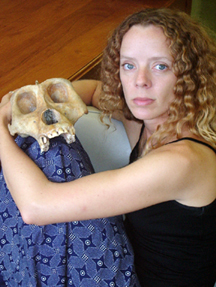
Read more: News Flash from AfricaFormer ESCONI Junior, Rebecca Rogers Ackermann, has been promoted to a full Professor at the University of Cape Town. Professor Ackermann is one of only three women professors of archaeology in Africa. Well done ESCONI!
-
Early trilobites had stomachs, new fossil study finds
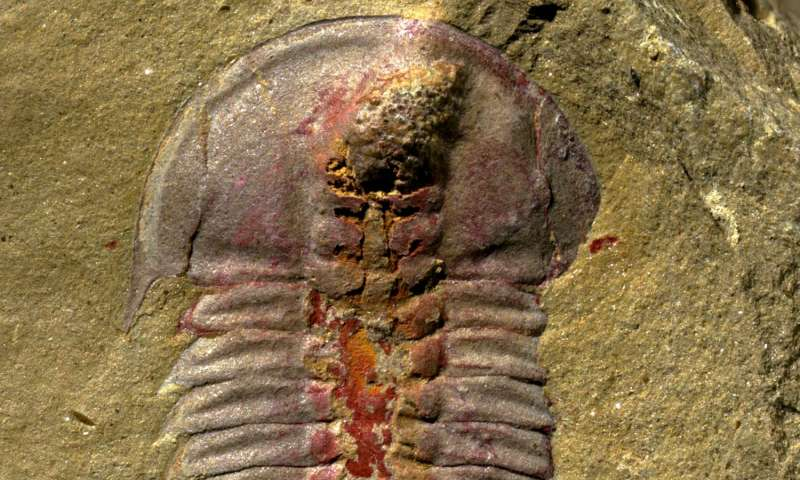
Read more: Early trilobites had stomachs, new fossil study findsA specimen of the trilobite Palaeolenus lantenoisi from the Guanshan Biota in southern Yunnan Province, China. Rarely are internal organs preserved in fossils, but this specimen shows the digestive system preserved as reddish iron oxides. The digestive system is comprised of a crop (inflated region at top of specimen), lateral glands, and a central canal that runs along the length of the body; the iron oxides that extend beyond the fossil are the remains of gut contents that were extruded during preservation. Credit: © F. Chen PHYS.ORG has a story about trilobites. Some new 500 million year old fossils from China reveal…
-
Field Trip Report: Braceville – Mazon Creek Fossils
Read more: Field Trip Report: Braceville – Mazon Creek FossilsBoth days had great weather and there was a big turnout… nearly 60 people on Saturday. Many concretions were exposed by the Summer rains. Andrew Young and a few others supplied opened concretions for some of the younger participants. It was a productive trip with many concretions collected for the Winter freeze thaw.
-
Reminder: September General Meeting on Friday, September 8th, 2017 – “Calymene blumenbachii and the Discovery of Trilobites”
Read more: Reminder: September General Meeting on Friday, September 8th, 2017 – “Calymene blumenbachii and the Discovery of Trilobites”The speaker at our September 8, 2017 meeting will be Dr. Don Mikulic, Senior Paleontologist with the Illinois State Geological Survey. The title of his program is “Calymene blumenbachii and the Discovery of Trilobites”. The program is based on a chapter in “Fantastic Fossils – 300 years of worldwide research on trilobites”, New York State Museum Bulletin 507. This book is available for download on ResearchGate under the account of Ed Landing. Account on ReasearchGate are free.
-

Heavily armoured dinosaur had ginger camouflage to deter predators – study
Read more: Heavily armoured dinosaur had ginger camouflage to deter predators – studyThe Guardian has a story about a recent paper that studied coloring in the best-preserved armoured dinosaur ever discovered. The specimen of Ankylosaur named Borealopelta markmitchelli, was discovered back in 2011 at the Suncor Millennium Mine in Canada. The discovery was a surprise as the site had previously only revealed fossils of ancient marine reptiles. The animal was about 18 feet long and lived about 110 million years ago. It was unveiled back in May 2017 and is currently on display at the Royal Tyrrell Museum of Paleontology in Alberta, Canada. This study looked at the preserved “skin” and determined…
-

Move over, Sue: World’s largest dinosaur taking center stage at Field Museum
Read more: Move over, Sue: World’s largest dinosaur taking center stage at Field MuseumThe Chicagoist has a great story about changes at the Field Museum. Sue is moving to her own space up inside Evolving Planet, and a new cast of the largest dinosaur every discovered will be installed in Stanley Field Hall. The new dinosaur, Patagotitan mayorum, a titanosaur from South America, will be installed in the Spring of 2018. Some literally massive changes are afoot at the Field Museum, as the beloved SUE the T. Rex will be moving from its famous entryway mount to a new gallery, making way for a touchable cast of a mammoth titanosaur—the world’s largest, in…

ESCONI Gem, Mineral, and Fossil Show
Most Recent Post
- Science Quickly: The dinosaurs at your window: How birds survived the asteroid that killed all other dinosaurs
 Scientific American’s “Science Quickly” had an interview with Steve Brusatte on a recent episode. Steve’s new book “The Story of Birds” is available to day April 28th, 2026.
- About ESCONI
- Around the Web
- Calendar of Events
- Code of Ethics and Conduct
- ESCONI Books for Sale
- ESCONI Gem, Mineral, and Fossil Show
- ESCONI in the News
- ESCONI Videos
- Field Trips
- Flashback Friday
- Fossil Friday
- Mazon Creek
- Mazon Monday
- Member Spotlight
- Membership Information
- Reference Material
- Throwback Thursday
- Trilobite Tuesday
Field trips require membership, but visitors are welcome at all meetings!
| Friday, April 10th | General Meeting – 8:00 PM via Zoom. Jessica Hull will present “Life in the Devonian Period, The Age of Fishes.” |
| Saturday, April 11th | Junior Study Group Meeting – 2:00 PM, in person at the College of DuPage Technical Education Center (TEC) Building – Room 1038A (Map). Katherine Howard will present on Sand and Sediment Collecting. Specifics of this meeting are available from Scott Galloway, 630-670-2591, gallowayscottf@gmail.com. |
| Saturday, April 18th | Paleontology Study Group – 7:30 PM via Zoom and in person at the College of DuPage, TEC, Room 1038B (Map). Keith Robitschek will present “Digging the Marl of the Lance Formation.” |
| Friday, April 24th | MAPS Expo XLVII – Springfield, IL. |
| Saturday, April 25th | MAPS Expo XLVII – Springfield, IL. |
| Sunday, April 26th | MAPS Expo XLVII – Springfield, IL. |
| No meeting this month | Mineralogy Study Group |