
-

Roy Plotnick: Where Late the Sweet Birds Sang
Read more: Roy Plotnick: Where Late the Sweet Birds SangRoy Plotnick has an insightful post over on Medium. It’s about the 6th mass extinction. News flash, just in case you’ve been hiding in a hole somewhere, it’s happening now. He is commenting on a recent paper in the journal science. This past summer, my wife and I took a lovely walk around Echo Lake in New Hampshire. What struck us, and we mentioned to a ranger, was the dearth of bird song. Despite the general solitude, all we heard was an occasional song in the distance. The only birds we saw were some ducks in the lake. Earlier this…
-

ESCONI Field Trip Report – Braceville Fall 2019
Read more: ESCONI Field Trip Report – Braceville Fall 2019The Fall 2019 trip to Braceville was on September 14th and 15th this year. The weather was great on Saturday, maybe a little hot for digging. On Sunday, the day started out wet, with a steady down pour in early morning, but a few hardy souls went in right from the beginning! It was two good days of fossil collecting, renewing old friendships, and making some new friends. It may take a little while with the freeze/thaw preparation, but hopefully, we’ll all come away with some awesome new fossils for our collections! With all the rain we have had this…
-
Reminder: Rock and Fossil Garage Sale – Saturday, September 21st and September 28th, 2019
Read more: Reminder: Rock and Fossil Garage Sale – Saturday, September 21st and September 28th, 2019There will be a sale of rocks and fossils from the collection of Dave and Sheila Bergmann on consecutive Saturdays, September 21st and 28th, 2019 at 401 S. Lombard Ave, Lombard, IL from 10:00 AM to 5:00 PM. Material for sale includes minerals and fossils in flats, as well as individual specimens. There will also be equipment, jewelry, and carvings along with some antiques, fishing equipment, lawn equipment and miscellaneous items.
-
ESCONI Flashback Friday #20: Jack Wittry Presents at the September 2009 General Meeting By Andrew Young
Read more: ESCONI Flashback Friday #20: Jack Wittry Presents at the September 2009 General Meeting By Andrew YoungAs part of the run up to ESCONI’s 70th Anniversary, here is Flashback Friday post #19. If you have pictures or stories to contribute, please send them over to esconi.info@gmail.com. Thanks! Jack Wittry gave a lecture entitled “Antediluvian Phytology” on Friday, September 11th, 2009. It was about the Mazon Creek fossil flora. The definitive reference book on the subject, The Mazon Creek Fossil Flora, had been published a few years prior in 2006. That book was authored by Jack and published by ESCONI. This lecture summarized much of the information in the book. Since then, an animal book called “The…
-

PBS Eons: How Pterosaurs Got Their Wings
Read more: PBS Eons: How Pterosaurs Got Their WingsPBS Eons has another episode. This one is about the origins of pterosaurs. Although the evidence is pretty sparse, we aren’t sure of their ancestors. Scleromochlus, or something like it, is a likely candidate. Watch the episode for more details… When pterosaurs first took flight, you could say that it marked the beginning of the end for the winged reptiles. Because, strangely enough, the power of flight — and the changes that it led to — may have ultimately led to their downfall.
-

New Jurassic World Short Shows Just How Screwed the Humans Are Now
Read more: New Jurassic World Short Shows Just How Screwed the Humans Are NowGizmodo has a piece about the new Jurassic World short “Battle at Big Rock”. Check it out! The Jurassic Park/World franchise has long flirted with the idea that humanity’s hubris in reviving dino-kind would inevitably lead to said dinosaurs wreaking havoc on the whole world, not just a remote island park and/or research facility. Now, in the wake of Fallen Kingdom’s set up, a new short finally delivers on the idea of humanity dealing with the consequences of its actions.
-
ESCONI Field Trip To St. Paul Quarry, in St. Paul, IN – October 25th, 2019
Read more: ESCONI Field Trip To St. Paul Quarry, in St. Paul, IN – October 25th, 2019There will be a field trip to St. Paul Quarry (Silurian; Waldron Shale) on Friday, October 25th, 2019. Please note: the date is subject to the Quarry’s work schedule and may be moved or canceled. You must be a member of ESCONI on or before Friday, October 11th, 2019 to attend. The quarry address is: 519 S. County Line Rd, St. Paul, IN 47272 (map). Their website is: https://newpointstone.com/st-paul/. Please email John Catalani at fossilnautiloid@aol.com to sign up for the trip. No phone calls.
-
Palaeocast Episode 103: Terror birds
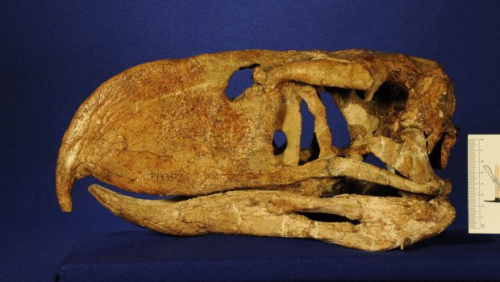
Read more: Palaeocast Episode 103: Terror birdsA new episode of Palaeocast is out. This one is about Terror birds. These are large flightless birds that evolved after the K-Pg extinction event. They originated in South America and migrated up to North America when the Isthmus of Panama formed almost 3 million years ago. Personally, I’ve always found these animals fascinating! Terror birds, or phorusrhacids as they are known scientifically, are a group of large, flightless birds that lived during the Cenozoic, and truly lived up to their name. Known for their large, powerful skulls, and enormous beaks, these birds are unlike the flightless birds we have…
-
Roy Plotnick: Forehead Aliens, Rishathra, and the Ecology of Alien Worlds
Read more: Roy Plotnick: Forehead Aliens, Rishathra, and the Ecology of Alien WorldsRoy Plotnick has another insightful post on Medium. This one is about evolutionary biology. As a Star Trek fan, I appreciate the writers attempt to explain within their universe what were actually constraints produced by the need to use human actors and save on CGI. Personally, I don’t think it was necessary (don’t get me started on their contortions to explain changes in the appearance of the Klingons). But as an evolutionary biologist, I am appalled. Even given that the original DNA of all nineteen planets was identical, the odds that the end result billions of years later would be…
-
Field Museum 6th Annual ID Day – Saturday, September 14, 10AM–2PM
Read more: Field Museum 6th Annual ID Day – Saturday, September 14, 10AM–2PMOn Saturday, September 14th, 2019, from 10:00 AM to 2:00 PM, join our annual ID Day at the Field Museum—free for Illinois residents. Bring in remnants of the natural world—including clean, dry bones, fossils, rocks, seashells, and photographs of the natural world—to be identified by the Field’s scientists. This year, ID Day will also include a poster-making station for the upcoming global Climate Strike. You provide the ideas and we’ll provide the supplies.
-
ESCONI Flashback Friday #18: So, Where’s The Shrimp? By Andy Jansen
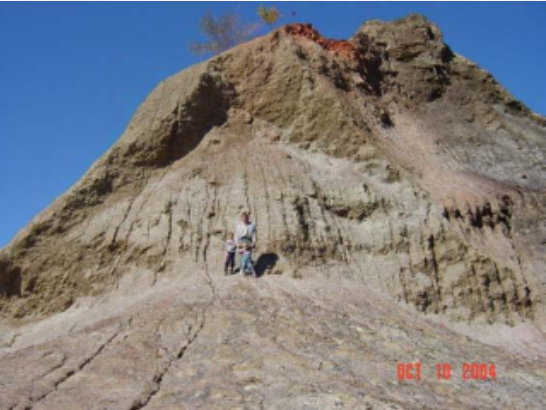
Read more: ESCONI Flashback Friday #18: So, Where’s The Shrimp? By Andy JansenAs part of the run up to ESCONI’s 70th Anniversary, here is Flashback Friday post #18. If you have pictures or stories to contribute, please send them over to esconi.info@gmail.com. Thanks! We have our Fall Braceville Field Trip coming up next weekend – September 14th and 15th, 2019. Here is an article about Braceville collecting and concretions from the December 2007 issue of “The Earth Science News”. The article is by Andy Jansen. Currently, Andy serves as Treasurer and Librarian of ESCONI. He’s a valuable member of the ESCONI Board, a great friend, and an all around awesome guy! His…
-
PBS Eons: When Bats Took Flight
Read more: PBS Eons: When Bats Took FlightPBS Eons has a new episode about bats. Bats are very rare in the fossil record and thus we still have much to learn about their evolutionary history. What came first flight or echo-location? Bats pretty much appear in the fossil record as recognizable, full-on, flying bats. And they show up on all of the continents, except Antarctica, around the same time. So where did bats come from? And which of the many weird features that bats have, showed up first?
-

The Brain Scoop: Recommended Reading: 2019!
Read more: The Brain Scoop: Recommended Reading: 2019!The Brain Scoop has an episode which highlights some good books. So, if you are looking to read something interesting and science related, these are some really good suggestions! Hi! I’m on the road filming PREHISTORIC ROAD TRIP, a 3-part series that will premiere nationally on PBS in 2020! We’ll get back to our regularly scheduled programming soon, but in the meantime check out these books! More about Prehistoric Road Trip: https://to.pbs.org/2z2bF9z “Timefulness: How thinking like a geologist can help save the world,” by Marcia Bjornerud https://www.goodreads.com/en/book/sho… “The Dinosaur Artist: Obsession, betrayal, and the quest for Earth’s ultimate trophy,”…
-
Former ESCONI Junior Rebecca Rogers Is Making A Mark In South Africa! #WomenInScience @FM_WomenInScience
Read more: Former ESCONI Junior Rebecca Rogers Is Making A Mark In South Africa! #WomenInScience @FM_WomenInScienceThis news story details how former ESCONI Junior Rebecca (Rogers) Ackermann is making having a big impact as a professor of Anthropology in South Africa. The video is of one of her lectures titled “The evolution of human diversity: The relative roles of chance, adaptation and ancient sex”. HERI’s Deputy Director Professor Rebecca Ackermann celebrated the culmination of Women’s Month by being awarded one of Mail & Guardian’s Women Changing South Africa 2019. Ackermann was given the honour for her achievements in “creating policies and spaces to eradicate the barriers that women — especially black women — face in…
-
Letters From Gondwana: The Great Female Scientists of the Victorian Era
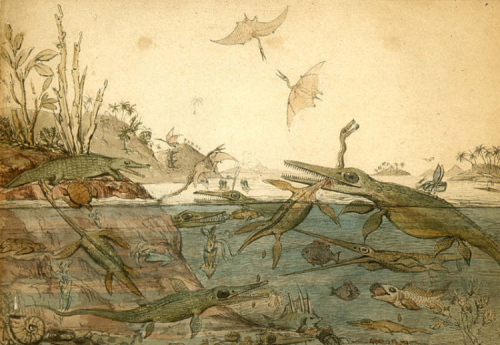
Read more: Letters From Gondwana: The Great Female Scientists of the Victorian EraThe blog Letters From Gondwana has a great post about the great female scientists of the Victorian Era. Of course, there’s Mary Anning and the Philpot sisters. Also included are Barbara Hastings, Etheldred Bennet, Mary Buckland née Morland, Charlotte Murchinson, Elizabeth Cobbold, Mary Buckland née Morland, Charlotte Murchinson, Mary Sommerville, Jane Marcet, Delvalle Lowry, and Arabella Buckley. These women made many contributions to the growing field of geology. Check it out! The nineteen century was the “golden age” of Geology. The Industrial Revolution ushered a period of canal digging and major quarrying operations for building stone. These activities exposed sedimentary…
-
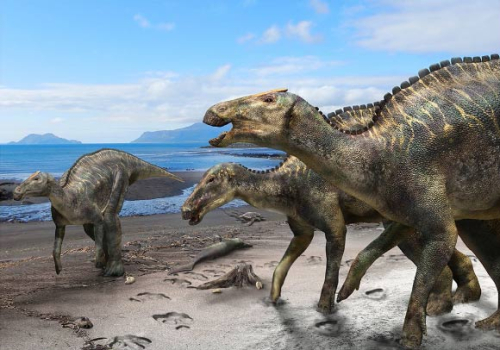
SciNews: New Duck-Billed Dinosaur Unveiled: Kamuysaurus japonicus
Read more: SciNews: New Duck-Billed Dinosaur Unveiled: Kamuysaurus japonicusScience News has an article about a newly described dinosaur from Japan. It’s a duck-billed dinosaur that lived 72 million years ago during the Cretaceous period. Named Kamuysaurus japonicus, it belongs to a family Hadrosauridae. All the details can be found in a paper in the journal Scientific Reports. The specimen was analyzed by paleontologists from Japan, the United States and Mongolia who concluded the dinosaur belonged to the hadrosaurid clade Edmontosaurini and was closely related to other hadrosaurids from the Far East such as Laiyangosaurus from China and Kerberosaurus from Siberia. “The individual was an adult aged 9 or older, measured 26 feet (8 m) long…
-
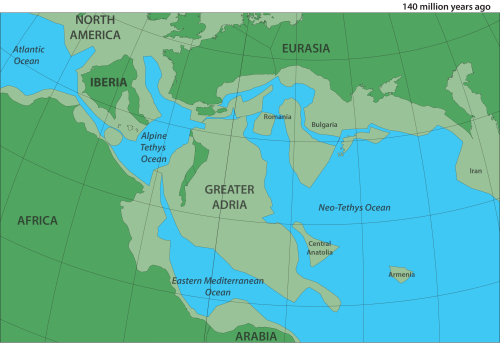
ScienceMag: Geologists uncover history of lost continent buried beneath Europe
Read more: ScienceMag: Geologists uncover history of lost continent buried beneath EuropeScience Magazine has a piece about the discovery of a lost continent under Europe. Plate tectonics has done much to reshape the surface of our planet over the last 4+ billion of years. It has created and destroyed super continents multiple time. And, most likely, it has erased large landmasses in the process of remolding our continents. Now, a group of geologists in Europe believe they have evidence of one of those erased landmasses. All the details are in a paper, which appeared in the Journal Gondwana Research. Forget the legendary lost continent of Atlantis. Geologists have reconstructed, time slice…
-
ESCONI Flashback Friday #17: Stephen J. Gould at the Field Museum
Read more: ESCONI Flashback Friday #17: Stephen J. Gould at the Field MuseumAs part of the run up to ESCONI’s 70th Anniversary, here is Flashback Friday post #17. If you have pictures or stories to contribute, please send them over to esconi.info@gmail.com. Thanks! On Thursday, September 14, 2000. ESCONI co-sponsored a Steven J. Gould lecture with the Field Museum. This was a huge event for ESCONI, with about 700 people attending. By all accounts, it was very successful. Too bad, Steven isn’t still with us, I’m sure that was a very interesting lecture. If you get a chance, read some of his books, he does a great job telling stories and presenting…
-
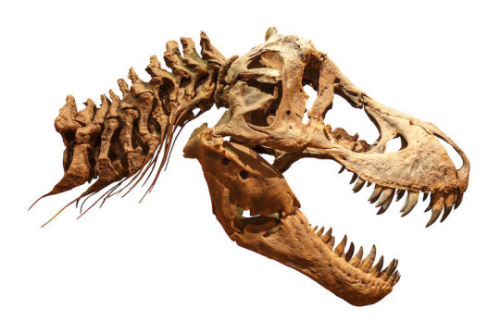
ScienceDaily: T. Rex had an air conditioner in its head, study suggests
Read more: ScienceDaily: T. Rex had an air conditioner in its head, study suggestsScience Daily has a post about Tyrannosaurs rex and how it might have handled the heat of the Cretaceous. As an animal gets bigger, it gets harder and harder to dump heat. That’s because the volume of its body grows faster than surface area as the body gets bigger. Researchers at the University of Missouri, Ohio University, and the University of Florida have an original idea about how one of the largest therapods cooled itself. The original paper appeared in the journal The Anatomical Record, 2019. A related video has more details. In the past, scientists believed two large holes in…
-
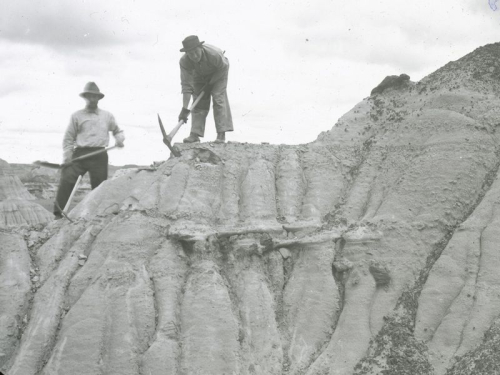
Smithsonian: How to Discover Dinosaurs
Read more: Smithsonian: How to Discover DinosaursOver on Smithsonian.com, Hans-Dieter Sues has an article about finding dinosaurs. The article answers many of the what, where, and how kind. People always ask, “How do you know where to dig?” Well, first we have to find a dinosaur skeleton before we can dig it up. To collect dinosaurs requires careful planning. Unless they are called on to salvage a skeleton already found during construction or mining, paleontologists begin their search for dinosaurs by studying geological maps and reports to identify locations where the rocks might yield dinosaur bones. After securing the necessary fieldwork permits, team leaders select volunteers,…

ESCONI Gem, Mineral, and Fossil Show
Most Recent Post
- Throwback Thursday #312: Ron Schinderle Donation
 Barb Schinderle stopped by ESCONI Show last month to drop off a donation of her late husband Ron’s fossils. Ron passed away in 2021. He was a long time ESCONI member and an avid fossil collector . He went on many ESCONI field trips. A group of us remember him fondly from our many trips to Pit 11 and Fossil Rock Campgrounds to collect Mazon Creek fossils.
- About ESCONI
- Around the Web
- Calendar of Events
- Code of Ethics and Conduct
- ESCONI Books for Sale
- ESCONI Gem, Mineral, and Fossil Show
- ESCONI in the News
- ESCONI Videos
- Field Trips
- Flashback Friday
- Fossil Friday
- Mazon Creek
- Mazon Monday
- Member Spotlight
- Membership Information
- Reference Material
- Throwback Thursday
- Trilobite Tuesday
Field trips require membership, but visitors are welcome at all meetings!
| Friday, April 10th | General Meeting – 8:00 PM via Zoom. Jessica Hull will present “Life in the Devonian Period, The Age of Fishes.” |
| Saturday, April 11th | Junior Study Group Meeting – 2:00 PM, in person at the College of DuPage Technical Education Center (TEC) Building – Room 1038A (Map). Katherine Howard will present on Sand and Sediment Collecting. Specifics of this meeting are available from Scott Galloway, 630-670-2591, gallowayscottf@gmail.com. |
| Saturday, April 18th | Paleontology Study Group – 7:30 PM via Zoom and in person at the College of DuPage, TEC, Room 1038B (Map). Keith Robitschek will present “Digging the Marl of the Lance Formation.” |
| Friday, April 24th | MAPS Expo XLVII – Springfield, IL. |
| Saturday, April 25th | MAPS Expo XLVII – Springfield, IL. |
| Sunday, April 26th | MAPS Expo XLVII – Springfield, IL. |
| No meeting this month | Mineralogy Study Group |