Category: Uncategorized
-
Notes From the Archaeology Group Meeting
On October 25, 2014 the archaeology study group was led by the study group chair Eric Schmidt. Eric discussed events leading up to, during and after the death of King Richard the third. Eric focused on the archaeology site, the dig, the finds, and the cause of death of King Richard the third. King Richard…
-
Palaeontology in a Drug Company Commercial
It’s nice to see that Palaeontology is getting a little attention. But, this is really just wrong. What is that a Knightia fossil from Fossil Lake next to a pterosaur head? Also, convenient that the pterosaur bones were already prepped out. Dr. Grant from “Jusassic Park” comes to mind… http://www.ispot.tv/ad/7MlV/eliquis-keep-digging Seems we have some educating…
-
More On Bird Evolution
Brian Switek has a great article on bird evolution on the blog Phenomena at National Geographic. The spark for this evolutionary explosion isn’t yet known. Flight could be a major factor, allowing birds to be adapted in starkly different ways from their earthbound ancestors. (Although, of course, nonavian dinosaurs like Microraptor found their own way into the air.)…
-
Paleocast Podcast
If you enjoy podcasts and palaeontology, you may find Palaeocast worth listening to!
-
A Mosasaur With a Few Clues
Mosasaurs have long been determined to be apex predators in the Cretateous oceans. But still, there has been questions as to what they ate. But now, from a mosasaur fossil found in 2008 in Alberta, Canada’s Korite International Ammolite Mine, there are some tantalizing clues. It is summarized nicely by Brian Switek in he Phenomena…
-
Mick Jagger is Namesake for Extinct Pig
The name of the extinct mammal is Jaggermeryx naida, or Jagger’s water nymph. It was sort of a mix between a slender hippo and a long legged pig. It lived about 19 million years ago in Egypt. After scientists studied the bone structure of the skull, it was determined to have a large tongue and…
-
New Cretaceous Dino Track Site in Moab
From the ESCONI mailing list on Yahoo: CNN video on a new Cretaceous dino track site in Moab, UT. Check it out through the link below. http://www.cnn.com/video/?/video/bestoftv/2014/08/22/dnt-fossils-unknown-species-discovered.cbc&hpt=hp_t4&from_homepage=yes&video_referrer=http%3A%2F%2Fwww.cnn.com%2F#/video/us/2014/08/20/dnt-dinosaur-tracks-125-million-years-old-utah.ksl Very Cool!
-
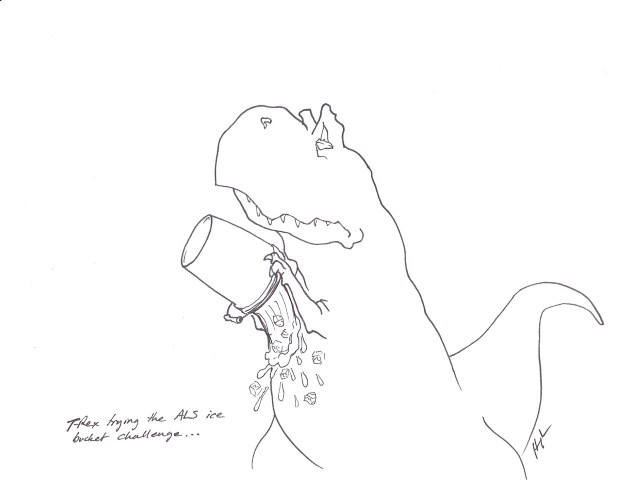
T-rex Trying to do the ALS ICE Bucket Challenge
There are a bunch more on that tumblr blog. Enjoy! Source: http://trextrying.tumblr.com/post/95434537359/t-rex-trying-the-als-ice-bucket-challenge
-
Honey, I shrunk the Theropods…
Interesting story by Darren Naish over at Scientific American. He unveils details of his paper in a recent issue of Science (August 1st, 2014). As, he states theropod dinosaurs (the “meat eaters”) were shrinking in size and becoming more and more “birdy” as time passed. What about Tyrannosaurus rex, you say? T-rex (and his/her large friends)…
-
Bob Bakker Delves Into Dino Guts
Bob Bakker on dinosaur internals, comparative anatomy and the evolutionary changes of hip bone orientation. As always, Bob is a good read. http://blog.hmns.org/2014/06/the-guts-stop-here-delve-deeper-into-dinosaurian-intestines-with-dr-bakker/
-
3.45 or 2.9 bya ?
Via Science news: Some of Earth’s earliest life-forms were thought to have left their mark roughly 3.45 billion years ago in minerals found in what is now the Barberton greenstone belt of South Africa. However, the minerals formed closer to 2.9 billion years ago, and the microstructures within them were not created by early microorganisms, scientists argue…
-
Grand Canyon Field Notes from Geotripper
Fascinating blog post about the Great Canyon from Geotripper: It’s Not What’s There in Grand Canyon That’s Incredible, It’s What’s Missing …. we paid a visit to an exposure of the “Great Unconformity” which is also seen in the bottom of the Grand Canyon. A participant noted that he had seen Copperfield make an elephant…
-
The Role of Amateur Paleontologists in Scientific Inquiry
A thoughtful, essay on the role of amateur paleontologists have played in both the past, as well as potentially in the future. Written for Palaeo-Electronica, by a member and leader in ESCNOI, John Catalini.
-
Canadian Paleo Artist – Csotonyi
Via the Verge: … These illustrations aren’t static — given the fast pace of scientific discovery, Csotonyi often has to update pieces to coincide with new revelations. The relatively new concept of feathered dinosaurs, in particular, has changed the way he renders these prehistoric giants. “I’ve had to return to several of my previous illustrations…
-
New Mineral Found In Australia
Via Science News: The new mineral is named putnisite after Drs Christine and Andrew Putnis from the University of Münster, Germany, for their outstanding contributions to mineralogy. Putnisite occurs as isolated pseudocubic crystals, up to 0.5 mm in diameter, and is associated with quartz and a near amorphous Cr silicate. It is translucent, with a…
-
Good Radio Interview About TRex at Smithsonian
http://onpoint.wbur.org/2014/04/22/montana-t-rex-smithsonian Tom Ashbrook interviews a number of people about the new Tyrannosaurus Rex at the Smithsonian and talks about its home – pre-historic Montana – and the age when dinosaurs ruled the Earth. John Horner, curator of paleontology at the Museum of the Rockies. Professor at Montana State University. (@dinodetective) Paul Sereno, paleontologist and professor…
-
Oldest Living Things
Via Wired: “… Animals sometimes sleep inside the hollows of giant 2,000-year old baobab trees in South Africa. Humans too, sometimes use old trees, for more dubious purposes — a jail, a toilet, a pop-up bar — as photographer Rachel Sussman discovered when she toured the world to photograph ancient trees and other organisms for…
-
XRaying for Diamonds
Via Gizmodo: “… The new process actually involves blasting chunks of kimberlite ore—where diamonds are most often found—a couple of times with X-rays from two different spectrums. This produces two distinct images of the same area that are then analyzed using a special algorithm developed by the EZRT. The newly developed technique is able to…
-
Carbon Hill Historical Museum Open House, 4/27
Michele Micetich sent this invitation a few days ago: Hello, I am the president of our historical society here in Carbon Hill, IL, just outside Coal City. We often have fossil collectors visit our little museum, the Carbon Hill School Museum, where we have much information on coal, fossils, immigrants, and the geology and geography…
-
Ice Age Bees from LaBrea
Via Science News: It’s not all mammoths and saber-toothed tigers. The first leafcutter bees from the Pleistocene epoch have turned up in the La Brea Tar Pits in Los Angeles. Exquisitely preserved as pupae undergoing their transformation to adulthood, a male and a female are still wrapped in their leafy nest. Micro-CT scans…
-
How To Drill Oil in North Sea
Via Atlantic: http://www.theatlantic.com/technology/archive/2014/04/how-to-drill-for-oil-in-the-brutal-conditions-of-the-north-sea/360262/ Maersk already has six rigs in the region, according to this company-produced video about “Life as a driller in the North Sea.” The employee featured here, Chris Hallan, has worked on the Innovator for nine years and will move to the Intrepid this spring. http://www.theatlantic.com/technology/archive/2014/04/how-to-drill-for-oil-in-the-brutal-conditions-of-the-north-sea/360262/_http://www.theatlantic.com/technology/archive/2014/04/how-to-drill-for-oil-in-the-brutal-conditions-of-the-north-sea/360262/
-
Extra eyes on ancestors of Harvestmen
Via Wired: Harvestmen (also known as daddy long legs) aren’t spiders, and if you could (or wanted to) lean close enough, you’d be able to see one of the few physical features that distinguish them from their arachnid cousins. It’s in the eyes: Spiders usually have 6 or more, but the harvestman has only one…
-
Footprints of Dino Chase
Via ScienceNews: … Footprints of a T. rex-type dinosaur chasing an Apatosaurus-like animal have been turned into a 3-D fly-through, giving researchers a way to verify maps of the tracks drawn 70 years ago. The tracks, from the Paluxy River in Texas, are among the most famous dinosaur footprints in the world. But the pathway…
-
Rumor Control
There’s a video going around that shows a long line of bison trotting down a road in Wyoming’s Yellowstone National Park. Some people are pointing to this as a sign that the animals are hightailing it out of the park because the Yellowstone volcano is about to blow its top. But in the video above,…
-
Furniture made from minerals need not say “Flintstones”
Via the NewYork Times: … At the Evolution Store, the designers admired a large chunk of polished petrified wood — part of an ancient tree that had fossilized to stone — noting that it would make an appealing (if heavy) stool. As Mr. Buntain said, “It’s a nice object because it’s quiet but has an…
-
Watching COSMOS? A Spacetime Odyssey
Fox Media’s new show, COSMOS: A Spacetime Odyssey is getting good reviews. It is on Sundays at 9/8C. Or you can watch it online too. It shares the wonder of the universe and of science.
-
Via Reuters, written by Will Dunham: Methane-spewing microbe blamed in Earth’s worst mass extinction “One important point is that the natural environment is sensitive to the evolution of microbial life,” said Daniel Rothman, an MIT geophysics professor who led the study published in the journal Proceedings of the National Academy of Sciences.
-
What is a disaster blog?
The Charlotte Observer tells us: Cataclysms and catastrophes: If something in nature explodes, collapses or crashes, you can probably read about it in Geology in Motion ( www.geologyinmotion.com), a blog by Susan Kieffer, emerita professor of geology at the University of Illinois at Champaign-Urbana. Q. You’ve written a book on the science of natural disasters,…
-
Dark Matter: Killer of Dinosaurs?
Via Nature A thin disk of dark matter running through the Galaxy might be behind the large meteorite strikes that are thought to be responsible for some of Earth’s mass extinctions, including that of the dinosaurs, two theoretical physicists have proposed….
-
Virus Back After 30,000 Years
Via Scientific American: Mar 4, 2014 |By Ed Yong and Nature magazine Larger than some bacteria, this virus — seen in a cross-section under a transmission electron microscope — was still able to infect amoebae despite having spent 30 millennia in a frozen state. Credit: Julia Bartoli & Chantal Abergel; Information Génomique et Structurale, CNRS-AMU In…
