Month: December 2011
-
Fracking and Quakes
From Wall Street Journal: The company leading efforts to unlock the U.K.’s potentially vast shale-gas reserves suffered a setback Wednesday after a report found it was “highly probable” a controversial production technique caused two small earthquake tremors in the country earlier this year. The report, which was financed by U.K. energy company Cuadrilla Resources Ltd.,…
-
Ferropericlase
Via ScienceDaily: The crushing pressures and intense temperatures in Earth’s deep interior squeeze atoms and electrons so closely together that they interact very differently. With depth materials change. New experiments and supercomputer computations have revealed that iron oxide undergoes a new kind of transition under deep Earth conditions. Iron oxide, FeO, is a component of…
-
Killer Claws
Via Science Daily: New research from Montana State University’s Museum of the Rockies has revealed how dinosaurs like Velociraptor and Deinonychus used their famous killer claws, leading to a new hypothesis on the evolution of flight in birds…
-
Saber Toothed Chicken
BoingBoing on the history of birds and dinosaurs: …The connection between dinosaurs and birds, while kind of flipping obvious once somebody points it out, was not much discussed among laypeople until I was in my teens. (That would be the 1990s, FYI.) But, among scientists, the idea of a dinosaur-bird relationship is nothing new. In…
-
Help in Identifying Fossils
The Fossil Forum web site offers a Fossil ID discussion board. Just post your photo and see what people think!
-
Dinosaur Artwork of the Past
Love in the Time of Chasmosaurs So many interesting photographs of dinosaur artwork and dinosaur parks, complete with commentary.
-
Google Unearths Archaeological Sites
Via USAToday: … Well, how about Google Earth instead? Like a friendly genie, that modern technology has started answering archeologist’s wishes with its worldwide catalog of satellite views of the Earth. A pair of studies in the Journal of Archaelogical Science this year suggest these views are revealing a vast and ancient story, one only…
-
13,800 Bone Spear
Via Science (October): … researchers report new analyses of the remains of a mastodon found in the 1970s with a bone spear point in its rib. Scientists used DNA and radiocarbon dating to demonstrate that the point came from a mastodon bone shaped into a weapon by humans and used a startling 13,800 years ago.…
-
New Quasicrystal
Via Scientific American: … A team of researchers says it has found in a Russian mineral sample the first natural example of a quasicrystal, an unusual material that displays some of the properties of a crystal but boasts a more intricate and complex structure. Since quasicrystals were characterized 25 years ago, numerous versions have been…
-
Mining Protests in Peru
Via BBC: …Mining is the main engine of Peru’s booming economy, but it is also the cause of numerous social conflicts around the country. The $4.8bn (£3.1bn) Conga project would be the biggest mining investment in the country’s history. On foot and on horseback, rural protesters climbed to four high mountain lakes whose waters would…
-
New Horned Dinosaur
Via Science Daily: … A new species of horned dinosaur was just announced by an international team of scientists led by Alf Museum staff, 95 years after the initial discovery of the fossil. The animal, named Spinops sternbergorum, lived approximately 76 million years ago in southern Alberta, Canada….
-
Antarctica Exposed
Via Washington Post: Map of Antarctica: … Although some of these mountains are as tall as the Alps, they’re still obscured by more than 3,200 feet of ice. The highest elevations are marked in this image in red and black, and the lowest are shown in dark blue. The light blue area shows the extent…
-
Finding Affordable Cabachons
Via Beading Daily: … there are over 700 named agates alone! One of the things I love best about wandering through the endless maze of gem dealers at the Tucson shows in February, in fact, is keeping any eye out for interesting and unusual stones, and many of them are quartz…
-
16,000 Lenses on Anomalocaris
Via New York Times: …The researchers report that anomalocaris had extraordinarily complex eyes, with 16,000 hexagonal lenses each. The findings appear in the current issue of the journal Nature….
-

Calendar of Events 2012
(Dates subject change) Sat. 1/21 January 2012 Sat. 1/7 Dinosaur Day at Lizzadro Museum. Fri. 1/13 General Meeting, 8:00 p.m. College of Dupage Building K, Room #161. Jack MacRae from the Willowbrook Nature Center will speak on “Local Discoveries of Mammoths and Mastodons.“ Sat. 1/14 Mineralogy and Micromount Study Group Meeting. 7:30 p.m. College of…
-
Ice Sheets Expand More Quickly Than Thought
Via PhysOrg: A fast-moving glacier on the Greenland Ice Sheet expanded in a geologic instant several millennia ago, growing in response to cooling periods that lasted not much longer than a century, according to a new Arctic study.
-
Princeton’s Art of Science Gallery 2011
Gorgeous photographs of artistic views of science – 2011 gallery from Princeton. You will have to click to see!
-
Breathtaking Photographs of Protoceratops Nest
From the National Geographic: “Breathtaking” Nest A nest full of fossilized dinosaur babies has been discovered in Mongolia, and the find has paleontologists reexamining styles of parental care among the ancient reptiles. The approximately 75-million-year-old nest shows 15 juvenile members of Protoceratops andrewsi—a relative of Triceratops—entombed in ancient sand dune deposits. The nest was recently…
-
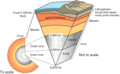
Age of Earth’s Core Older Than Thought
Via geology.com from Michigan Tech: Researchers at Michigan Tech, the University of Rochester and Yale University have determined that Earth’s core could be at least 1.2 billion years older than previously thought…. Image: USGS
-
Florida Muck Preserved Mastodon and More
View Larger Map Via Daytona Beach Journal DAYTONA BEACH — A week after workers stumbled upon remains of an Ice Age mastodon on a construction site, experts say Florida has a unique collection of natural conditions that make it one of the best places in the nation to find preserved fossils. The dark black muck…
-
Book Review on Acrocanthosaurus: The Bones of Contention
Via BC Books: Acrocanthosaurus: The Bones of Contention, by Russell Ferrell, is a story that’s as amazing as the dinosaur bones discovery around which the adventure unfolds. The book is populated by two larger than life heroes along with a cast of sharply drawn characters from the worlds of paleontology, politics, government, corporations, and contract…
-
Mineral and Fossil Sale, Saturday, December 10, Clarksville IN
Giant Mineral and Fossil Sale December 10, from 9:00 am – 4:30 pm Announcing a unique one day sale at the Falls of the Ohio Interpretive Center! Giant Mineral and Fossil Sale: How big is it? The entire lobby will be filled with specimens! The Gordon and Jean Unger collection of minerals, crystals, fossils, rocks, books,…
-
Pachyrhinosaurs perotorum in Honor of Ross Perot
Via Alaska Dispatch: … Years of research by Fiorillo, curator of the Museum of Nature and Science in Dallas, and painstaking reconstruction by Ronald Tykoski, the museum’s chief fossil preparator, confirmed that this was a type of pachyrhinosaurus — a relative of triceratops — that had not been found anywhere else…. …They have named the…
-
Oldest Painting Found in Central Europe – 15,000 yrs old
Via Spiegel: They may only be a series and red and brown spots, but they still constitute one of the most important works of art ever made in Central Europe. The spots were discovered on stones in a cave in southern Germany, and are the oldest known signs of painting ever found in the region.…
-
This Saturday – Holiday Party & Rock Contest
Mineralogy and Micromount Study Group. 7:30 p.m. College of Dupage, Building K, Rm 161. Wild and wacky holiday mineral identification contest! Bring three mineral specimens to be included in the identification contest, and any favorite holiday treats you like.
-
Ozone Release as a Predictor of Earthquakes?
Via Research and Development: New research, published this week in the journal Applied Physics Letters, suggests that ozone gas emitted from fracturing rocks could serve as an indicator of impending earthquakes. Ozone is a natural gas, a byproduct of electrical discharges into the air from several sources, such as from lightning, or, according to the…
